


Loop Engineering
Loop engineering is the craft of designing the loop that tells an AI agent what to do next over and over, so you no longer have to sit there typing prompts yourself.
[h6odua]
[hgyfn2]
[wgy8gq]
Loop engineering refers to building repeatable, self-directing workflows around AI agents, where the system—not a human—controls a recurring cycle of planning, acting, observing results, and deciding what to do next until a goal is met or a stop condition triggers.
[hgyfn2]
[wgy8gq]
[50knp0]
[u4fivn]
[28kzev]
[26dpxt]
It applies wherever agents need to work autonomously over multiple steps, such as AI coding assistants, customer-service bots, or task orchestration systems, and matters because it turns brittle, one-shot prompting into robust, auditable control systems that can run safely at scale.
[hgyfn2]
[wgy8gq]
[5uukfp]
[x2uv2j]
[u4fivn]
[28kzev]
[26dpxt]
[3h40ul]
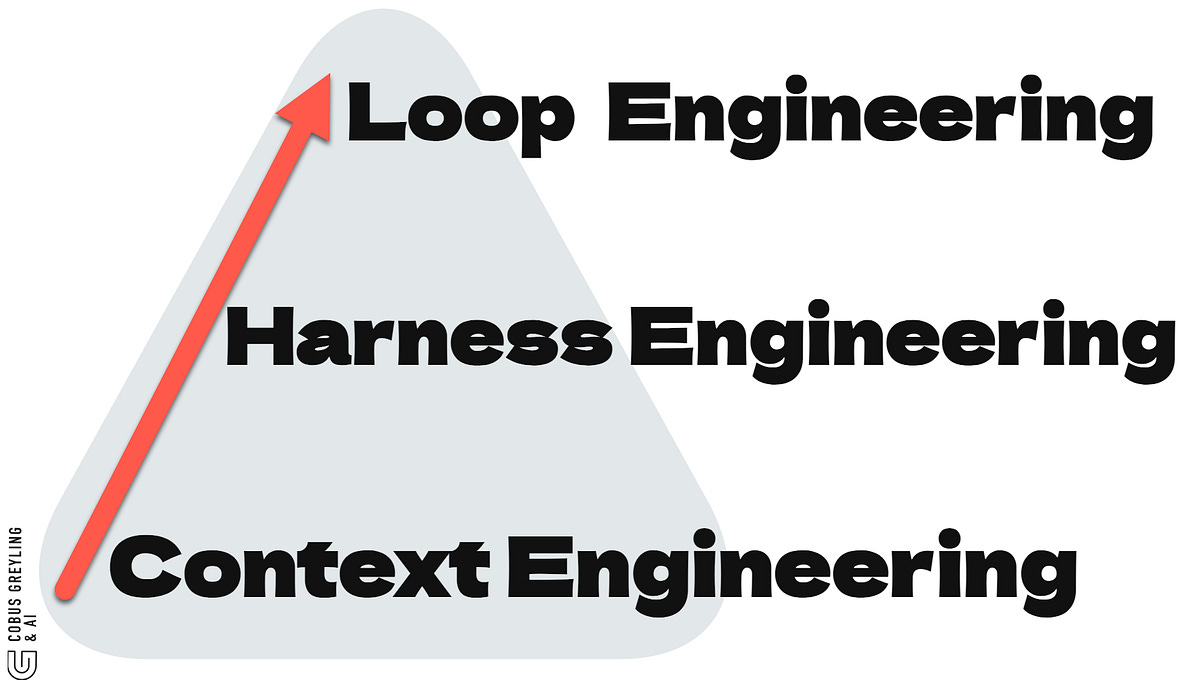
Writers from the indie and startup ecosystem frame it as the next step after prompt, context, and harness engineering: instead of optimizing individual prompts, you engineer the outer control loop around capable but fallible agents.
[h6odua]
[hgyfn2]
[wgy8gq]
[acfp3p]
[dubvf1]
[9glmy4]
[3h40ul]
In this sense, loop engineering explicitly brings ideas from feedback control and cybernetics into modern AI agent design, treating the loop—not the model call—as the primary unit of engineering.
[hgyfn2]
[u4fivn]
[dubvf1]
[9glmy4]
[3h40ul]

Defining and Describing Loop Engineering
Loop engineering is commonly defined as the practice of designing, operating, and improving the feedback loops that let AI agents iteratively work toward a goal with minimal human prompting.
[hgyfn2]
[5uukfp]
[50knp0]
[u4fivn]
[28kzev]
[26dpxt]
Addy Osmani summarizes it as: “Loop engineering is replacing yourself as the person who prompts the agent. You design the system that does it instead.”
[h6odua]
[50knp0]
[rapy8y]
[dubvf1]
Other explainers echo this, stating that loop engineering “means designing the repeatable process an agent runs inside, not prompting it harder one step at a time” and that the agent “reads the current state, chooses an action, checks the result, and decides whether to continue, retry, recover, or stop.”
[wgy8gq]
Across sources, a loop is described as a recursive or repeated goal-seeking cycle where the system keeps instructing the agent and evaluating results until a success or stopping condition is reached.
[h6odua]
[hgyfn2]
[50knp0]
[acfp3p]
[28kzev]
[dubvf1]
[26dpxt]
Most treatments emphasize several core characteristics:
- Verification and safety: Authors stress independent checks and audit trails: “verifies the results independently, persists state between runs, and decides whether to stop, retry, or escalate to a human.” [u4fivn] [dubvf1] This is framed as essential for production-grade, safety-critical loops. [hgyfn2] [5uukfp] [u4fivn] [28kzev] [26dpxt]
- Discipline and mindset: Some writings describe loop engineering less as a narrow technique and more as a mindset of “creating an environment where ‘improvement continues to cycle’” and where prompts and harnesses are allowed to evolve based on execution results. [9glmy4]
Several sources explicitly distinguish loop engineering from earlier practices:
Several commentators explicitly connect loop engineering to cybernetics and control theory, describing it as “applying the ancient wisdom of cybernetics to the AI agent scenario” and emphasizing the design of observation–decision–action cycles.
[3h40ul]
[u4fivn]
[dubvf1]
[9glmy4]
In this framing, the loop—rather than any one prompt—is the primary unit of design and optimization.
[dubvf1]
[3h40ul]
flowchart TD
S["Start goal"]
O["Observe current state"]
P["Plan next action"]
A["Act with AI agent"]
C["Check and verify result"]
D{"Decide next step"}
H["Human escalation"]
X["Stop loop"]
S --> O
O --> P
P --> A
A --> C
C --> D
D -->| "Continue" | O
D -->| "Retry or recover" | P
D -->| "Escalate" | H
D -->| "Goal met or blocked" | X
This kind of process flow—observe, plan, act, check, decide, repeat or stop—is the canonical structure described across loop engineering guides and essays.
[hgyfn2]
[wgy8gq]
[50knp0]
[u4fivn]
[28kzev]
[26dpxt]
[3h40ul]
Uses in Context
- AI-coding-agent vendors describe loop engineering as the discipline of structuring AI-assisted software development around repeated cycles of action and feedback, where agents “plan work, change code, observe results, and revise their approach until a software task is complete.” [hgyfn2] [acfp3p] [28kzev] [26dpxt]
- Practitioner blogs in Japanese and French describe loop engineering as a mindset of creating “an environment where ‘improvement continues to cycle’” and clarifying that it specifically refers to “boucles agentiques… des systèmes qui pilotent des agents IA de manière itérative avec un objectif et une condition d’arrêt.” [x2uv2j] [9glmy4]
- Some commentators explicitly frame loop engineering as “the latest evolution of prompt engineering,” emphasizing that it builds on, but goes beyond, prompt and context tricks by adding explicit state, verification, stopping conditions, and escalation paths. [x2ez5b] [h6odua] [hgyfn2] [acfp3p] [3h40ul]
- Social-media summaries pitch it to practitioners as “the disciplined engineering of the outer control cycle around capable but fallible agents,” highlighting tasks like discovering work, orchestrating agents, verifying results, persisting state, and deciding to “stop, retry, or escalate to a human.” [dubvf1]
History of Use
Origins
Most sources trace the popularization of “loop engineering” in the AI-agents context to Addy Osmani, an engineer known for developer tooling, who published an essay titled “Loop Engineering” in June 2026.
[h6odua]
[50knp0]
[dubvf1]
In that piece he defined the term as “replacing yourself as the person who prompts the agent” and framed a loop as “a recursive goal where you define a purpose and the AI iterates until complete.”
[h6odua]
[50knp0]
[dubvf1]
Shortly after, multiple independent practitioners and startups—writing in English, Japanese, and French—picked up the phrase, citing or paraphrasing Osmani’s definition while elaborating their own perspectives on loops as systems that prompt agents, verify results, and manage state until a goal or stop condition is reached.
[hgyfn2]
[wgy8gq]
[x2uv2j]
[u4fivn]
[28kzev]
[rapy8y]
[dubvf1]
[9glmy4]
These early discussions emerged in blog posts, social media threads, and startup documentation rather than in academic papers or large-incumbent whitepapers, indicating a grassroots origin in the agent-tools ecosystem.
[h6odua]
[hgyfn2]
[wgy8gq]
[u4fivn]
[dubvf1]
[3h40ul]
Evolution
- June 2026 – Concept articulation in blog essays and explainers: In mid‑June 2026, several independent explainers (e.g., What’s AI, Kilo AI, MindStudio, CodeRabbit) published introductions to loop engineering, converging on the definition of designing the repeatable process or workflow around an agent so it can act, observe, and iterate until a goal is met. [hgyfn2] [wgy8gq] [acfp3p] [28kzev] [26dpxt] These pieces emphasized coding agents and developer workflows as primary early applications. [hgyfn2] [acfp3p] [26dpxt]
- June 2026 – Expansion as a mindset of continuous improvement: Around the same time, Japanese-language essays described loop engineering as “a mindset where prompts, context, and harnesses are not just designed once and finished, but are allowed to grow continuously based on execution results,” emphasizing continuous improvement and learning cycles rather than static workflow design. [9glmy4]
- Late June–July 2026 – Formalization as agentic workflow design: Subsequent posts and concept pages (including in French and from startups building agent platforms) narrowed the term to “boucles agentiques,” stressing that loop engineering is specifically about systems that iteratively pilot AI agents with goals and stopping conditions, including state management, verification, audit trails, and escalation to humans. [x2uv2j] [u4fivn] [dubvf1] Commentators explicitly connected it to cybernetics and business process control, framing it as a systematic discipline rather than a collection of prompt tricks. [u4fivn] [dubvf1] [3h40ul]
- Mid–late 2026 – Adoption by larger vendors as a descriptive label: Later in 2026, some established vendors and enterprise-focused sites published “What is Loop Engineering?” explainers, defining it as “designing agentic workflows, or loops, that iteratively guide AI agents toward completing user-defined goals with minimal human intervention,” thus adopting and popularizing a concept that had already been defined by independent practitioners and startups. [5uukfp] [50knp0]
Best Real-World Examples
- CodeRabbit – Positions loop engineering as “moving beyond manual interactions with your coding agents” to engineer autonomous loops that execute coding tasks, tests, and revisions until a goal is met without human prompts at every step. [acfp3p]
- MindStudio – Promotes loop engineering as “the practice of designing AI agent workflows that operate in continuous, self-directed cycles,” with constructs like
/loop,/goal, and/routinesto keep agents working until a defined condition is satisfied. [28kzev] [26dpxt] - SFEIR concept page – Offers a French-language definition of Loop Engineering focused on “la boucle” that discovers work, delegates to agents, verifies results, persists state, and decides the next action until an objective is reached, clarifying what is not included (e.g., generic feedback loops). [x2uv2j]
- Zenn / AllNew case write‑up – Describes loop engineering as “designing and controlling the entire loop in which an AI agent operates autonomously,” including observation, planning, execution, verification, correction, stopping, and escalation to humans in production systems. [u4fivn]
- IBM Think explainer – Adopts the term to describe enterprise “agentic workflows” where agents act, observe, make decisions, and iterate toward user-defined goals with minimal human intervention, popularizing the concept in a broader business audience. [5uukfp] [50knp0]
Case Studies
1. AI Coding Loops at Kilo AI
In an article on AI feedback loops for coding agents, Kilo AI defines loop engineering as “the practice of designing, operating, and improving the feedback loops that let AI coding agents plan work, change code, observe results, and revise their approach until a software task is complete.”
[hgyfn2]
Their framing highlights a concrete loop: given a task, the agent plans a sequence of edits, applies changes, runs tests or checks, observes the results, and then decides whether to adjust the plan or continue, repeating until tests pass or a stop condition is reached.
[hgyfn2]
This approach shifts software development from single-shot code generation to an iterative, agent-driven workflow where verification and state (e.g., test results, diffs, failures) are first-class inputs to each subsequent step.
[hgyfn2]
The case shows how loop engineering can transform coding assistants from tools that “spit out code once” into systems that participate in an ongoing develop–test–fix cycle with minimal human prompting beyond the high-level goal.
[hgyfn2]
[acfp3p]
[26dpxt]
2. Autonomous Agent Workflows at MindStudio
MindStudio’s blog presents loop engineering as “the practice of designing AI agent workflows that operate in continuous, self-directed cycles rather than responding to a single prompt.”
[28kzev]
[26dpxt]
In their description, a loop-engineered agent “observes the current state, reasons about what to do next, executes an action, and evaluates the result — repeating this cycle until a defined goal is met,” with constructs like
/loop, /goal, and /routines used to keep agents working autonomously.
[28kzev]
[26dpxt]
They emphasize state management (tracking progress and environment), verification (checking whether actions moved the system closer to its goal), and stopping conditions (declaring success or escalation) as integral design elements.
[28kzev]
[26dpxt]
This case illustrates loop engineering as a general-purpose methodology for agent workflows beyond coding: the same observe–reason–act–evaluate loop can orchestrate tasks in customer support, operations, or data processing systems, provided that the checks and state representation are carefully engineered.
[28kzev]
[26dpxt]
[u4fivn]
3. Process-Control Perspective in the Zenn / AllNew Production Case
A Zenn article from the AllNew team describes loop engineering as “a philosophy of designing and controlling the ‘loops’ in which AI agents operate autonomously, rather than having humans input prompts for every single action.”
[u4fivn]
For production systems, they argue that a proper loop isn’t “just automatic execution” but must include “state management, verification, stopping conditions, audit trails, memory, and escalation.”
[u4fivn]
They liken loop engineering to business process control design, enumerating stages such as observation, planning, execution, verification, correction, stopping, and escalation to humans when necessary.
[u4fivn]
This case study shows loop engineering functioning as a bridge between classical control/process engineering and modern AI agents: the loop is treated as a controllable, auditable process with explicit safeguards, rather than a black box of repeated API calls, which is crucial for deploying agents in production environments where safety, traceability, and reliability are paramount.
[u4fivn]
[dubvf1]
[3h40ul]