


High-Density Compute
Hyperscalers
AI Factories
Datacenters
Datacenter Builders
The AI Model Wars
AI Compute Cloud Providers
Defining and Describing High-Density Compute
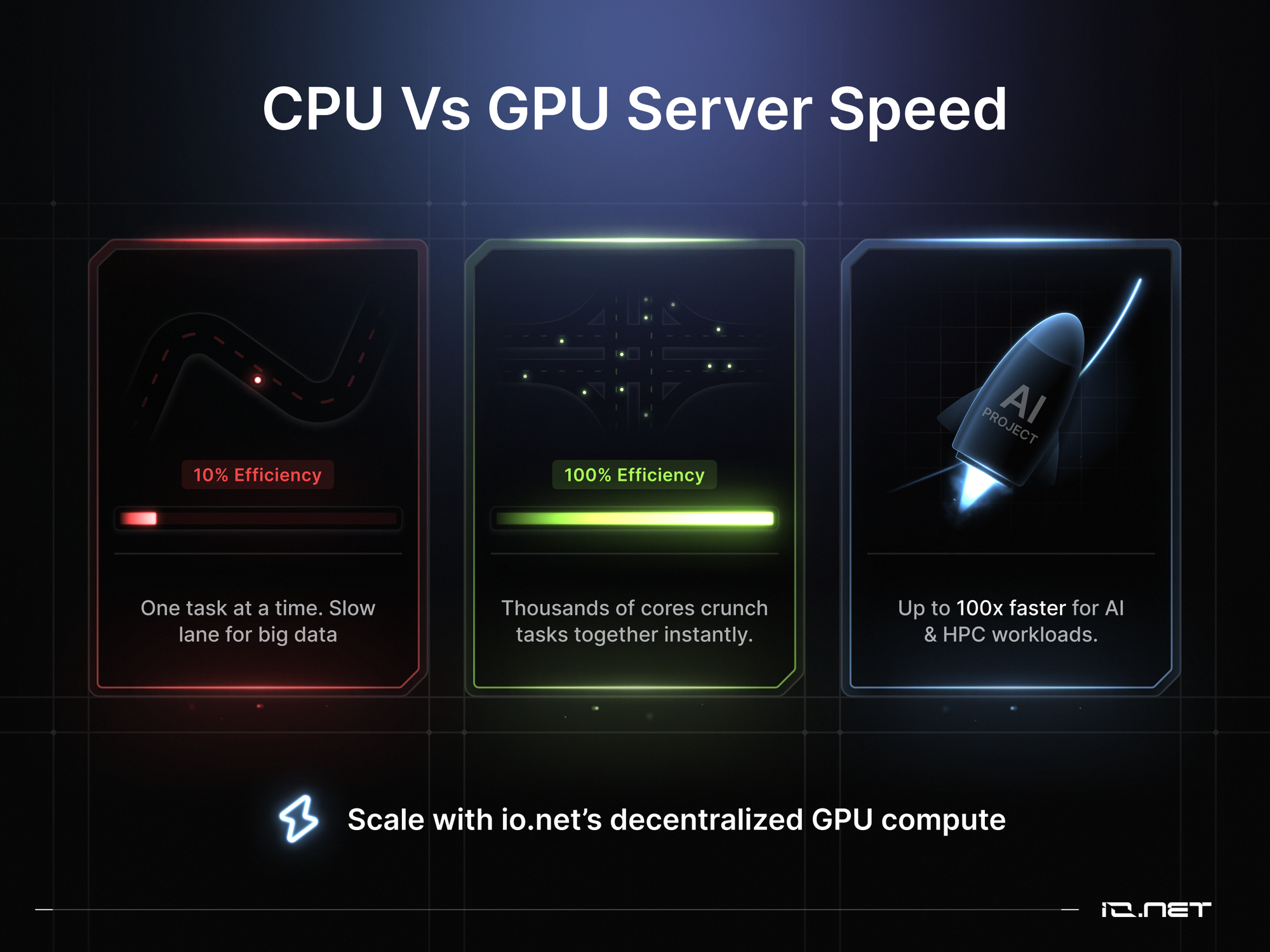
High-density compute concentrates unusually large amounts of processing capacity, power demand, and heat generation into a limited physical footprint.
High-density compute is an infrastructure pattern in which substantial processing capacity is concentrated in relatively few racks or physical enclosures.[4] It is most closely associated with AI, GPU computing, high-performance computing (HPC), and other compute-intensive workloads.[4] Compared with conventional IT, it requires more deliberate design of power delivery, networking, thermal management, and facility operations because higher compute concentration produces greater power and heat density.[4][6]
flowchart LR
I["Compute workload"] --> A["Accelerated processors"]
A --> N["High bandwidth network"]
N --> P["Dense power delivery"]
P --> C["Advanced cooling"]
C --> O["High density compute output"]
Uses in Context
- AI infrastructure: The term describes facilities and clusters built around GPUs or other accelerators for training and serving AI models.[4][6]
- Data-center planning: Operators use it to distinguish racks with unusually high power draw from conventional server deployments; a typical AI rack can exceed 100 kW, while a conventional cloud rack is often described as drawing 5–15 kW.[10]
- Thermal engineering: High-density compute is invoked to justify direct-to-chip, rear-door heat-exchanger, or immersion-cooling systems when air cooling becomes insufficient.[1][2][10]
- HPC: The phrase covers tightly coupled computational environments in which many accelerators operate as a coordinated system rather than as isolated servers.[10]
- Sustainability discussions: It is used when evaluating how to deliver more compute while controlling cooling energy, water consumption, and facility footprint.[1][3][13]
History of Use
Origins
The available search results do not identify a definitive first academic paper, book, or inventor for the exact phrase “high-density compute.” The underlying idea predates the current AI infrastructure cycle: it describes the concentration of processing capacity in a constrained physical space, with corresponding increases in power and heat density.[4] Contemporary usage is primarily an infrastructure and data-center term applied to AI, GPU, and HPC deployments.[4][6]
Evolution
- Before the current AI wave: High-density computing was associated broadly with HPC and accelerator-based systems, where compute-intensive workloads required concentrated processing capacity and specialized facility design.[4]
- AI accelerator era: Large GPU clusters expanded the meaning from “many processors in a small space” to a coordinated system requiring high-bandwidth east-west networking, specialized fabrics, and tightly integrated power and cooling.[10]
- 2025–2026: The term increasingly became associated with liquid-cooled AI infrastructure, including direct-to-chip cooling, immersion cooling, modular data centers, and cooling-intelligence software.[1][2][5][13]
Best Real-World Examples
- Submer — immersion-cooling systems that replace conventional air-cooling infrastructure and support higher-density compute.[1]
- Flexnode — prefabricated, liquid-cooled modular data centers designed for high-density workloads.[1]
- Crusoe — AI data-center infrastructure pairing high-density compute with direct-to-chip cooling and lower-carbon power strategies.[1]
- Corintis — microfluidic, chip-level cooling intended to remove heat directly from silicon with minimal water use.[3]
- KühlTherm — an Ahmedabad-based startup developing direct-to-chip, rear-door, and immersion-cooling systems for AI and HPC infrastructure.[5]
- InfiniBand — a high-performance fabric used to synchronize communication across large GPU clusters, helping a data center operate as a tightly coupled supercomputer.[10]
- AWS Project Rainier — an example of a hyperscale AI deployment designed around high-density workloads, custom silicon, and advanced cooling; it represents large-scale adoption rather than the origin of the concept.[10]
Case Studies
Submer and immersion cooling. Submer Group , founded in Barcelona in 2015 by Daniel Pope and Pol Valls, developed systems that submerge servers in non-conductive liquid.[1] The approach removes much of the conventional air-cooling infrastructure and is intended to reduce energy use while enabling higher-density compute.[1] The case illustrates that high-density compute is not simply a matter of installing more processors: the thermal system becomes part of the computing architecture.
Crusoe’s AI infrastructure. Crusoe combines high-density AI compute with closed-loop, direct-to-chip cooling and an energy strategy centered on lower-carbon power.[1] Its design goal is to keep GPUs operating efficiently under demanding thermal conditions while reducing the water and energy burden associated with conventional cooling.[1] The example shows how newer infrastructure companies compete by integrating power, compute, and cooling rather than treating the data center as a neutral container.
KühlTherm’s liquid-cooling platform. Founded in 2025, KühlTherm develops direct-to-chip cooling, rear-door heat exchangers, immersion systems, coolant-distribution units, and its NexusFlow OS platform for AI data centers and HPC environments.[5] The company raised $1.1 million in seed funding in 2026 to accelerate deployment of these technologies.[2][5] Its case demonstrates the emergence of specialized startups addressing the facility-level consequences of accelerator density, including thermal throttling, cooling efficiency, and scalable rack design.[5]
Sources
[1]: Five Startups Reducing Data Center Water Consumption
[2]: KuhlTherm raises $1.1 mn seed funding led by Arkam ...
[3]: Net Zero Insights' Post
[4]: High-Density Computing: Requirements, Challenges & ...
[5]: KuhlTherm Secures $1.1 Million Seed Funding
[6]: High-density data center solutions for AI & HPC | NorthC
[7]: KuhlTherm Raises $1.1 Million Seed Funding Led by Arkam ...
[8]: KuhlTherm raises $1.1M for AI data centre liquid cooling
[9]: KuhlTherm Launches Made-in-India Liquid Cooling ...
[10]: The AI Sky Above the Clouds - Intel Capital
[11]: AI Data Centers: Definition, Architecture & Requirements
[12]: KühlTherm is targeting 2GW of manufacturing capacity by ...
[13]: Top 15 AI Data Center Liquid Cooling Companies in 2026
[14]: Articles tagged 'liquid cooling' - The Storm Media
[15]: Liquid Cooling Market Matures: Innovations, Acquisitions, and Modular Solutions for AI Infrastructure