


General Adversarial Networks
Defining and Describing General Adversarial Networks
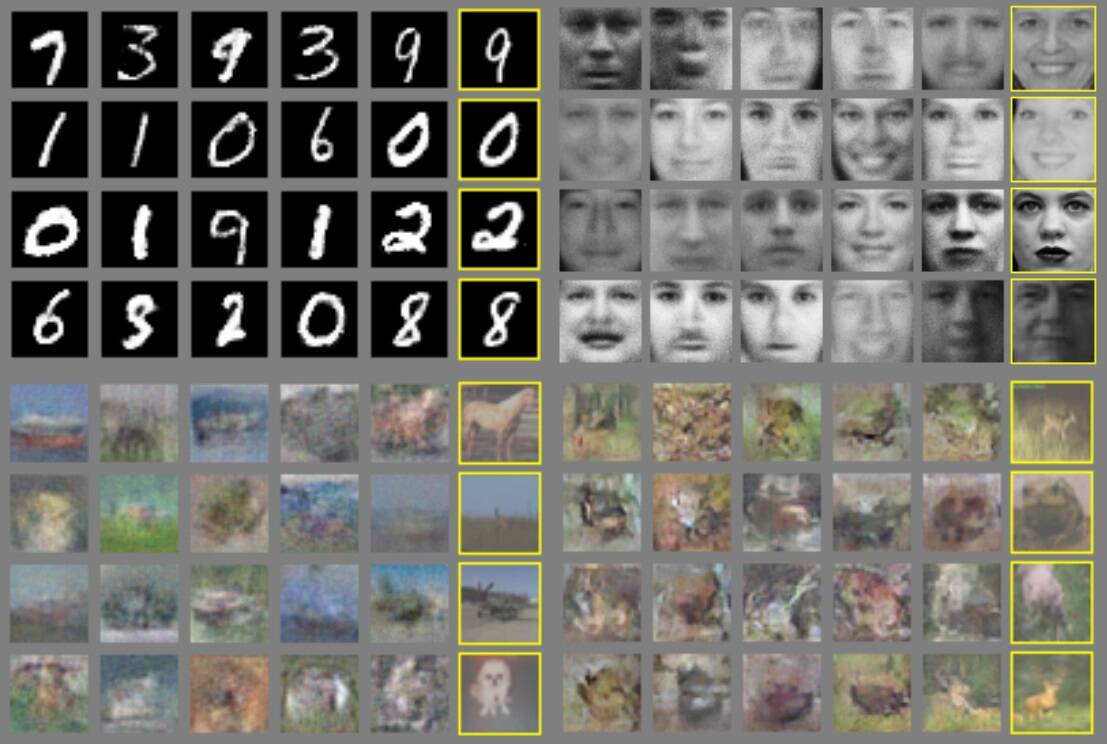
- A GAN is a generative-model framework in which a generator creates synthetic samples and a discriminator estimates whether samples are real or generated. [r03s7p] [60u83r] The two models are trained competitively: the generator improves at producing realistic data, while the discriminator improves at detecting fabricated data. [fy7yh6] [qj58cd]
- GANs apply when a system must learn a data distribution and generate new examples resembling its training data, including images, video, audio, and other high-dimensional data. [t95jwi] [wjfmd4] Their importance comes from replacing explicit sample-generation rules with an adversarial training process based on backpropagation. [og2nu2]
flowchart LR
A["Random input"] --> B["Generator"]
B --> C["Synthetic sample"]
C --> D["Discriminator"]
E["Real sample"] --> D
D --> F["Real or generated judgment"]
F --> B
F --> D
Uses in Context
- Popular explanation: GANs are often explained through a “counterfeiter” and “police officer” analogy: the generator fabricates samples, and the discriminator attempts to catch them. [fy7yh6]
History of Use
Origins
Evolution
Best Real-World Examples
- Original Generative Adversarial Nets — the foundational 2014 framework by Goodfellow and seven co-authors, using a generator–discriminator minimax game. [wjfmd4] [60u83r]
- MNIST GAN experiments — an early demonstration of the original framework on handwritten-digit data. [lk06vh] [4mx7es]
- CIFAR-10 GAN experiments — an early application to natural-image data described in historical summaries of the original paper. [lk06vh] [4mx7es]
- TensorFlow GAN — a software-oriented example of GAN methods being incorporated into an open machine-learning ecosystem; the supplied results do not provide detailed product evidence, so this identification should be treated as contextual rather than fully documented here.
- StyleGAN — a prominent later GAN family for high-fidelity image synthesis; the supplied search results establish GANs’ image-generation role but do not provide a source-specific account of StyleGAN.
- Deepfake-generation systems — GAN-based synthetic-media systems illustrate the technology’s use in realistic audiovisual fabrication; the supplied search results support the broader image, video, and audio application but do not document a particular deployment. [t95jwi] [d3diva]
Case Studies
The 2014 Montreal research contribution. Ian Goodfellow and seven collaborators introduced the GAN framework in “Generative Adversarial Nets,” posted in 2014 and presented at NIPS that year.
[fy7yh6]
[wjfmd4]
Their design trained two models simultaneously: a generator intended to capture the data distribution and a discriminator intended to estimate whether an example came from the training data rather than the generator.
[r03s7p]
[60u83r]
This changed generative-model training by expressing it as an adversarial competition rather than relying solely on an explicitly specified likelihood or sampling procedure.
[og2nu2]
The case demonstrates that the core innovation was an academic research contribution, not a technology-company product launch.
The generator–discriminator training loop. In a typical GAN, the generator receives random input and produces a candidate sample, while the discriminator compares generated samples with real training examples.
[fy7yh6]
[qj58cd]
The generator is optimized to fool the discriminator, and the discriminator is optimized to distinguish authentic from synthetic data.
[fy7yh6]
[wjfmd4]
Repeating this competition can produce samples that resemble the training distribution, which explains why GANs became associated with realistic image, video, and audio generation.
[t95jwi]
[d3diva]
The case also shows why “General Adversarial Networks” is not the standard name: the documented framework is specifically Generative Adversarial Networks .
[t95jwi]
[wjfmd4]
From research framework to generative-media method. After the original 2014 publication, GANs became a recognized approach for synthesizing high-dimensional data and were used as a conceptual basis for systems generating realistic visual and audio content.
[t95jwi]
[wjfmd4]
The generator–discriminator structure provided an intuitive account of how synthetic samples could improve through competition: the generator learned from the discriminator’s judgments, while the discriminator learned from exposure to generated samples.
[fy7yh6]
[qj58cd]
This illustrates both the strength and limitation of the concept: GANs offer a powerful mechanism for realistic synthesis, but the supplied sources do not establish a single canonical commercial deployment or a complete history of later variants.
Sources
[fy7yh6] GAN Paper Deep Dive: How Generative Adversarial Networks Ushered in the Era of AI-Generated Content
[60u83r] Generative Adversarial Networks (Goodfellow et al., 2014 ... [8]: Réseaux antagonistes génératifs (GAN) : guide complet | Lenovo FR