


Fabless Manufacturing
Defining and Describing Fabless Manufacturing
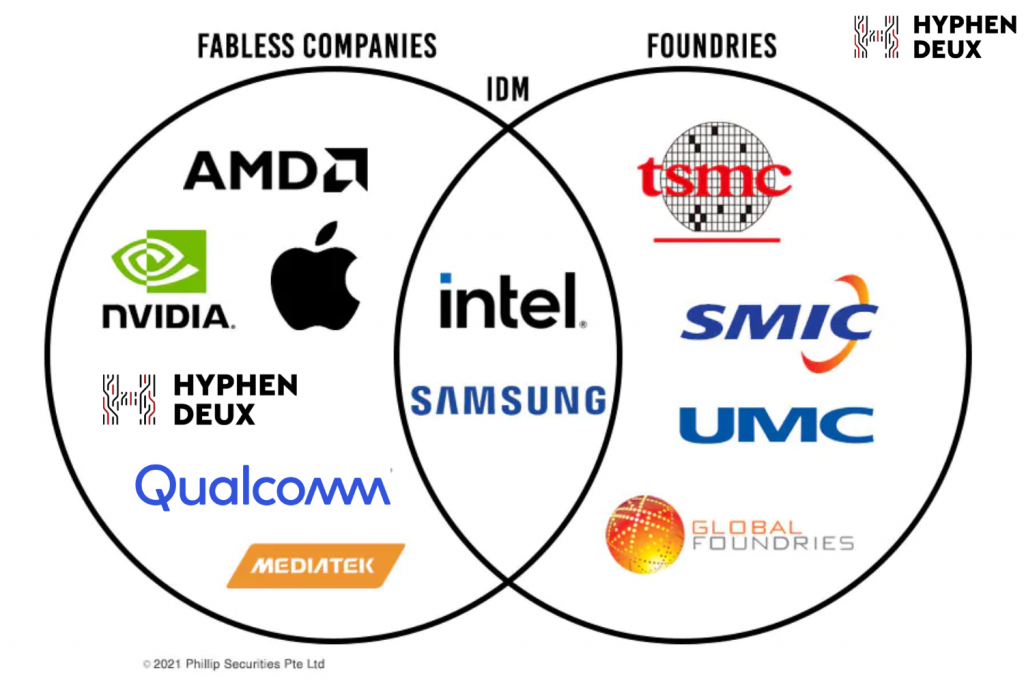
- Fabless manufacturing is a semiconductor business model in which a company designs and sells chips while outsourcing physical fabrication to a specialized foundry.
- In an innovation-consulting context, the term applies when a startup or established design house owns the product architecture, chip design, intellectual property, and usually commercialization, but does not own the wafer-fabrication plant. [1][2] It does not mean that every activity is outsourced: design verification, software integration, product definition, and sometimes packaging, testing, or supply-chain management may remain internal. [3][15] Consultants care about the model because it lets founders direct capital and talent toward differentiated IP rather than building and operating a highly capital-intensive fab, while introducing dependence on foundry capacity, process compatibility, cost, yield, and geopolitical supply risk. [3][7][11]
Disambiguation
Primary sense — the innovation-consulting sense
Fabless manufacturing is an innovation and operating model in which a semiconductor company develops and commercializes chip designs but contracts their physical production to independent semiconductor foundries. [1][2]
- The central organizational split is between design-led value creation and manufacturing execution : the fabless firm concentrates on architecture, circuit design, IP, software, and product-market fit, while the foundry fabricates wafers to the supplied specifications. [3][9][15]
- For startups, the model can reduce the need for fab ownership and shift scarce capital toward engineering, verification, tooling, and customer development; a startup guide describes it as the “most common route for a new IC design house.” [7]
- Fabless does not mean “no manufacturing strategy.” Foundry selection, process-node choice, wafer allocation, packaging, testing, yield learning, quality control, and lead-time management remain consequential operating decisions. [11][15]
- It is different from a foundry model: a foundry manufactures chips designed by other companies, whereas a fabless company designs and sells the chips but outsources fabrication. [2][11] It is also different from an integrated device manufacturer , which designs and manufactures semiconductors in facilities it owns or operates.
Other senses
1. Fabless as a semiconductor-company category
A fabless semiconductor company is a firm classified by the absence of owned wafer-fabrication capacity, regardless of whether it performs other manufacturing-related activities through contractors. [5][12]
- Industry analyses commonly define the category as companies conducting semiconductor research, design, development, and sales while outsourcing physical wafer fabrication to third-party foundries. [5][15]
- The category is useful for market mapping and investment analysis because it separates design/IP economics from the capital expenditure and process-engineering economics of fabrication. [11][15]
- “Fabless” is therefore a structural description, not automatically a claim that the company is asset-light in every respect: advanced packaging, testing, inventory, design tools, and tape-out costs can still require substantial resources. [15]
2. Fabless manufacturing as a broader outsourced-production label
In looser usage, fabless manufacturing can describe a product company that retains design and commercialization while contracting production to specialist manufacturers; the established and technically precise usage, however, is primarily semiconductor-related. [1][12]
- The semiconductor sense is anchored in “fab,” the industry term for a fabrication plant, and in the foundry relationship that produces physical silicon from a company’s design. [1][8]
- Applying “fabless” to ordinary consumer-product outsourcing can obscure important differences in tooling, process ownership, intellectual-property control, qualification, and semiconductor supply-chain economics; contract manufacturing or outsourced manufacturing is usually more precise in those cases.
Etymology and Origin
- “Fabless” is a contraction of fabrication-less : the company lacks its own semiconductor fabrication plant, or “fab,” and sends fabrication to a specialist manufacturer. [1][8]
- The model emerged as semiconductor entrepreneurs could design and sell integrated circuits without owning a fabrication facility, while specialized foundries supplied manufacturing capacity to multiple design companies. [2]
- Sources variously identify early fabless pioneers, including LSI Logic and Chips and Technologies; the historical record is therefore better described as an industry transition than as a term with one uncontested inventor. [4][14]
- The model became strategically important with the rise of dedicated foundries, especially TSMC, founded by Morris Chang in 1987; foundries provided non-competing manufacturing capacity that enabled independent chip designers to scale without building fabs. [2][4]
Adjacent Vocabulary
- Synonyms :
- Fabless semiconductor model — the most precise equivalent when discussing company strategy and industry structure. [5]
- Fabless chip design — emphasizes design entrepreneurship and is especially common in startup, regional-development, and engineering contexts. [10]
- Outsourced semiconductor manufacturing — understandable but broader; it can include companies that also own some fabrication capacity.
- Design-house model — emphasizes a company’s role as an IC design specialist, though it does not always imply that all fabrication is outsourced.
-
- Antonyms :
- Integrated device manufacturer (IDM) — a semiconductor company that combines chip design with manufacturing in company-owned or company-operated fabs.
- Captive manufacturing — production performed within facilities controlled by the product company.
- In-house fabrication — direct ownership or operation of the relevant semiconductor manufacturing capacity.
-
- Adjacent terms : semiconductor foundry , integrated device manufacturer , ASIC , SoC , chip design , advanced packaging
Usage in Practice
- “Fabless manufacturing is a business model in which a company designs and sells semiconductor chips but outsources the physical manufacturing process to a specialist third party.” [1]
- “A fabless company strategically outsources the entire physical production of its chips to specialised, independent foundries,” allowing it to focus on “architecture, logic design, and software integration.” [3]
- “A fabless semiconductor company designs chips in-house and outsources manufacturing to a foundry,” keeping capital focused on “design and IP rather than fabrication.” [7]
- The FPGA industry’s shift was described as a decision to “eschew building wafer fabrication facilities” and contract with other companies to manufacture the silicon; the resulting model focused companies on “design, innovation, and marketing.” [6]
- “Fabless companies design chips without owning fabrication capacity,” concentrating investment in “intellectual property, architecture, and software” while outsourcing manufacturing to foundry partners. [5]
- The model separates “the capital-intensive, process-driven fabrication stage” from “the innovation-intensive, design-driven IP creation stage.” [15]
Common Misuses
- Calling any company that outsources assembly or final production fabless : use contract manufacturing unless the company specifically designs semiconductors and outsources wafer fabrication.
- Describing a fabless startup as “manufacturing-free”: use fabless semiconductor company or design-led semiconductor company , because the firm still manages design verification, qualification, supplier relationships, packaging, testing, and production ramp decisions. [15]
- Treating fabless as synonymous with asset-light : use capital-light relative to owning a fab ; chip design, electronic-design-automation tools, verification, prototypes, tape-outs, inventory, and engineering remain expensive. [7][11]
- Saying that fabless companies have no operational control over production: use outsourced fabrication ; the design company still selects process technology, negotiates capacity, defines specifications, and manages foundry execution. [11][15]
Sources
[1]: What Is Fabless Manufacturing? - TechRound
[2]: Fabless manufacturing - Wikipedia | Encyclopedia
[3]: Guide to ASIC Design with Open Source Tools | PakCrypt
[4]: Fabless
[5]: Semiconductor Fabless Market Size, Growth Industry Report, 2026
[6]: Milestones
[7]: How to start a semiconductor company in 2026: a 10-step guid - JIM
[8]: How Fabless Companies Function, and Key Examples Explained
[9]: Fabless - Vocab
[10]: Fabless Chip Design, Indian STEM Entrepreneurship, and ...
[11]: The Semiconductor Value Chain: Fabless, Foundries, and ...
[12]: Fabless Manufacturing Explained
[13]: Understanding the Fabless Profit Structure and the AI Chip ...
[14]: The fabless revolution
[15]: Semiconductor Fabless Market in the World | Report - IndexBox ...