


Digital Currencies
Defining and Describing Digital Currencies
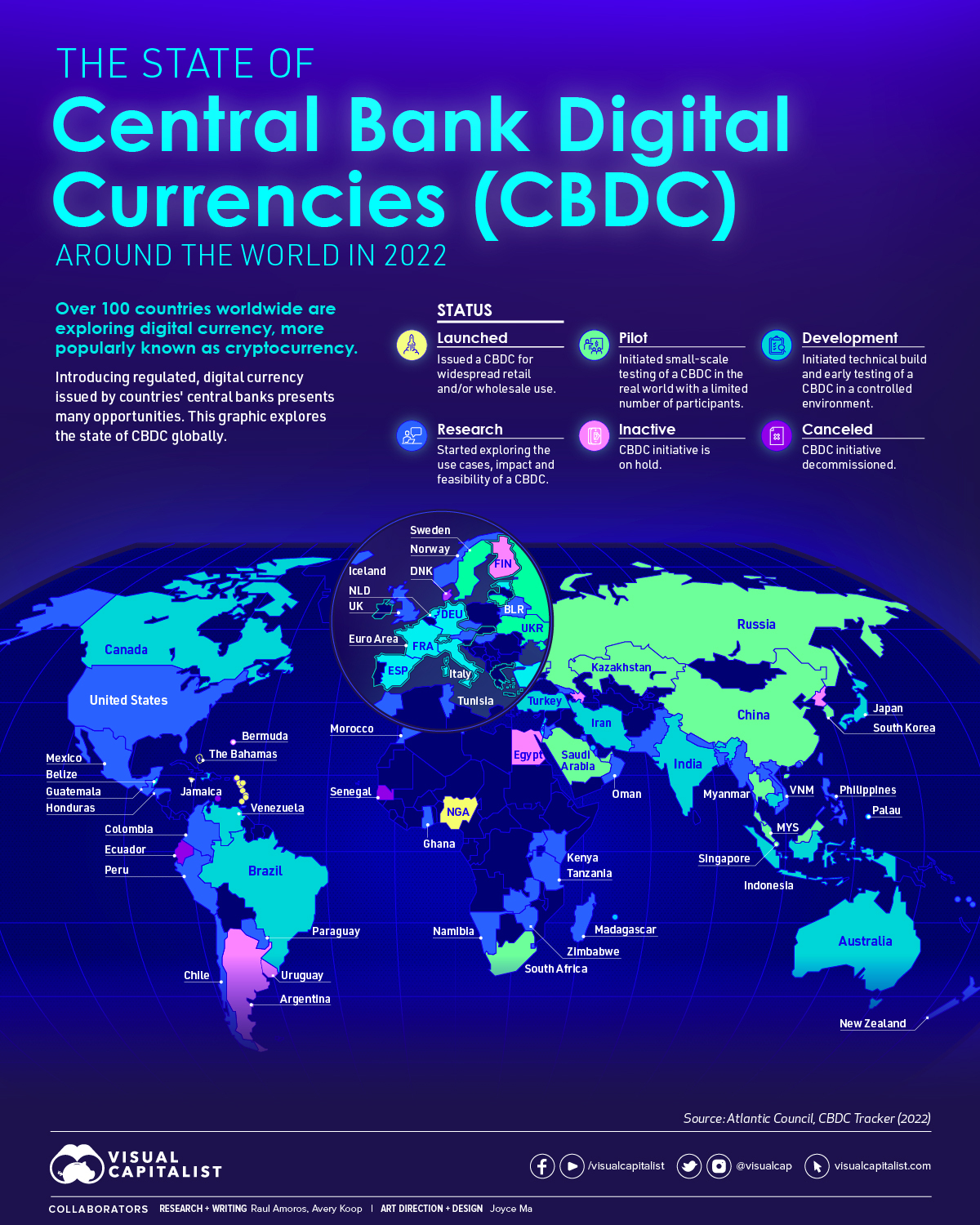
- Digital currencies are electronically represented monetary or payment assets that startups, institutions, and consumers can use to transfer value without relying on physical cash.
- In innovation consulting, the term is most useful as an umbrella for several distinct models: privately issued cryptocurrencies and stablecoins, electronic money, and central bank digital currencies (CBDCs). [uhje5m] It does not mean every digital payment: a card transaction or ordinary bank-account transfer may be digital without constituting a distinct digital currency. The distinction matters because each model creates different founder choices around issuance, trust, programmability, compliance, distribution, interoperability, and adoption.
Disambiguation
Primary sense — the innovation-consulting sense
- The category includes decentralized cryptoassets such as Bitcoin and Ethereum, privately issued stablecoins, electronic money, and state-backed CBDCs. [uhje5m]
- Digital currency is not synonymous with digital payment. Payment applications may transmit conventional bank deposits or fiat balances without creating a new currency.
Other senses
1. Private digital currencies and cryptoassets
- For founders, this sense raises questions about token utility, network effects, governance, liquidity, custody, security, and whether decentralization produces meaningful user or business value.
- Not every token is money: some tokens represent access, governance rights, securities, or claims on assets rather than a general medium of exchange.
2. Stablecoins
- They are often designed for payment and global circulation, making them relevant to cross-border commerce, treasury operations, remittances, and programmable financial products. [8jfk7p]
- Product teams must evaluate reserve quality, redemption rights, issuer solvency, compliance obligations, and the reliability of the infrastructure on which the token operates.
3. Central bank digital currencies
- CBDCs may be designed for retail users, interbank settlement, or financial-market infrastructure; wholesale CBDCs target institutional settlement rather than ordinary consumer payments. [8jfk7p]
- For innovation strategy, CBDCs matter as possible changes to payment rails, public infrastructure, bank intermediation, identity systems, and cross-border settlement.
- Central banks had used digital forms of money and payment for decades before CBDC became established terminology. [kf8aqe]
Etymology and Origin
- Earlier electronic-cash experiments included Finland’s Avant smart card in 1993, while David Chaum’s company developed an early form of anonymous electronic cash in 1995. [vty9ex]
- CBDC terminology and policy attention developed later, with CBDCs proposed around 2013 and gaining momentum as central banks responded to cryptocurrencies and Facebook’s 2019 Libra proposal. [9wbl9h]
Adjacent Vocabulary
- Synonyms :
- Electronic money : broader and often more centralized; can include stored monetary value used through payment systems. [uhje5m]
- Digital money : near-synonym, often emphasizing the monetary function rather than the asset or infrastructure.
- Cryptoasset : narrower than digital currency; covers tokens that may not function as money.
- Virtual currency : commonly used for privately issued or non-sovereign digital value, but its boundaries vary by jurisdiction. [kf8aqe]
-
- Antonyms :
- Commodity barter : exchange without a monetary digital or physical unit.
- Offline bearer payment : value transfer relying primarily on physical possession rather than networked digital records.
- Adjacent terms :
- Cryptocurrency
- Central Bank Digital Currency
- Tokenization
- Programmable Money
- Digital Payments
-
Usage in Practice
- “Digital currency” can function as an umbrella term covering “electronic money such as Suica and PayPay,” cryptoassets, CBDCs, and stablecoins. [uhje5m]
- Bitcoin is described as “a decentralized digital currency” proposed in Nakamoto’s 2008 white paper. [uhje5m]
- A CBDC is a “digital form of a country’s sovereign currency” and a direct digital claim on the state. [yiua8p]
- Stablecoins are “privately issued digital tokens backed by safe assets,” often intended for global circulation. [8jfk7p]
- Tokenization allows “financial claims—including money, securities, and derivatives—to be represented as programmable digital tokens recorded on shared ledgers.” [8jfk7p]
Common Misuses
- Calling every card payment or bank transfer a “digital currency” is imprecise; digital payment is the better term when the underlying balance remains an ordinary bank deposit.
- Calling every crypto token a currency overstates its monetary role; use cryptoasset , utility token , governance token , or security token according to the instrument’s function.
- Describing a stablecoin as “digital cash” can conceal issuer and reserve risk; privately issued payment token is more precise.
Sources
[tnkj0c] 2026, Jul 01. onlinelibrary.wiley.com . The Digital Currency Revolution: A Survey of Its Evolution, Current Practices, and Implications . Updated: 2026, Nov 05. Generated: 2026, Nov 06. Perplexity API response.
[107a0u] 2026, Apr 02. academic.oup.com . Dollar hegemony in the digital age: an infrastructural ... . Updated: 2026, Nov 06. Generated: 2026, Nov 06. Perplexity API response.
[vty9ex] 2026, Mar 23. tandfonline.com . USD hegemony, bitcoin, Central Bank Digital Currency and ... . Updated: 2026, Oct 22. Generated: 2026, Nov 06. Perplexity API response.
[kf8aqe] 2026, Jan 02. tandfonline.com . Central Bank Digital Currencies—An Introductory Note . Updated: 2026, Sep 06. Generated: 2026, Nov 06. Perplexity API response.
[yiua8p] 2026, Aug 21. pxp.io . Central Bank Digital Currency: Definition, How It Works . Updated: 2026, Oct 28. Generated: 2026, Nov 06. Perplexity API response.
[8jfk7p] 2026, Apr 02. elibrary.imf.org . Tokenized Finance in: IMF Notes Volume 2026 Issue 001 (2026) . Updated: 2026, Oct 30. Generated: 2026, Nov 06. Perplexity API response.
[uhje5m] 2026, May 21. instituteofgeoeconomics.org . Digital Currencies and Monetary Hegemony Part II of III . Updated: 2026, Nov 06. Generated: 2026, Nov 06. Perplexity API response.
[f38h1h] 2026, Jun 23. link.springer.com . Regulating Central Bank Digital Currencies: Towards a Conceptual Framework - Journal of Banking Regulation . Updated: 2026, Nov 03. Generated: 2026, Nov 06. Perplexity API response.
[q118yp] 2026, Oct 01. imf.org . Central Bank Digital Currency (CBDC) - Virtual Handbook - IMF . Updated: 2026, Nov 05. Generated: 2026, Nov 06. Perplexity API response.
[9wbl9h] 2026, Jun 18. cambridge.org . Background and History of Central Bank Digital Currencies (Chapter 2) - Totalitarian Money? . Updated: 2026, Jun 30. Generated: 2026, Nov 06. Perplexity API response.