


Decision Science
(2025-11-26T14:41.520Z)
Perplexity Query
(2025-11-26T14:41
.520Z)
Question:
Write a comprehensive one-page article about "Decision Science".
Model: sonar-pro
Decision Science
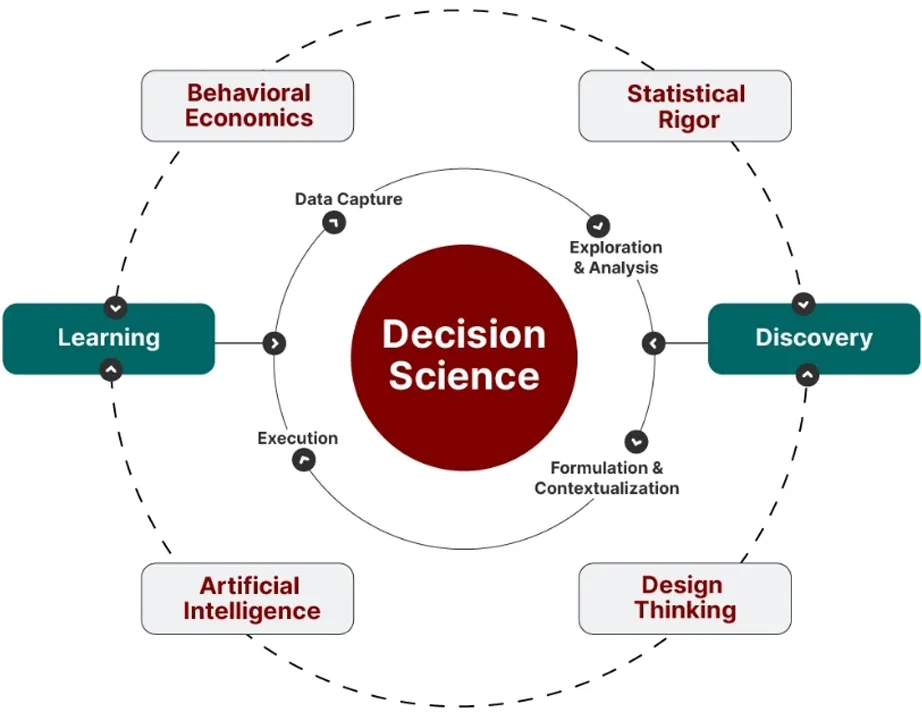
Decision Science is an interdisciplinary field that combines insights from mathematics, statistics, psychology, economics, and computer science to study and improve the decision-making process. It seeks to understand how individuals and organizations make choices, and to develop tools and frameworks that help them make better, more informed decisions in complex and uncertain environments. In an era defined by rapid change and information overload, Decision Science is increasingly vital for navigating personal, professional, and societal challenges.

Main Content
At its core, Decision Science is about enhancing the quality of decisions by systematically analyzing information, evaluating alternatives, and minimizing biases. The field is often divided into two main approaches: the normative approach, which focuses on how decisions should be made using rational models and optimization techniques, and the behavioral approach, which examines how people actually make decisions, often influenced by cognitive biases and heuristics. By integrating these perspectives, Decision Science provides a comprehensive toolkit for improving decision-making at all levels.
Practical applications of Decision Science are widespread. In business, it aids strategic planning, market analysis, and resource allocation, helping companies gain a competitive edge. For example, a retail chain might use Decision Science to optimize inventory levels, balancing the risk of stockouts against the cost of excess inventory. In healthcare, it supports treatment planning and resource allocation, improving patient outcomes and operational efficiency. Governments and policymakers use Decision Science to evaluate policy options, assess their impact, and make choices that maximize public welfare. In finance, it plays a crucial role in portfolio management, investment analysis, and risk assessment, enabling organizations to make informed investment decisions and manage financial risks.
The benefits of Decision Science are clear: it helps organizations and individuals make more effective, evidence-based decisions, reduce uncertainty, and mitigate risks. However, there are also challenges to consider. Decision models are only as good as the data and assumptions they are based on, and there is always the risk of over-reliance on quantitative methods at the expense of qualitative insights. Additionally, cognitive biases can be difficult to overcome, even with the best tools and frameworks. Despite these challenges, the principles and methodologies of Decision Science continue to drive success and improve outcomes across a wide range of domains.
Current State and Trends
Decision Science is now widely adopted across industries, from business and finance to healthcare and government. Major corporations, particularly in sectors like oil and gas, pharmaceuticals, and technology, have implemented Decision Science tools for strategic decisions, often facing high stakes and long development timeframes. The field is supported by professional organizations such as the Society of Decision Professionals and the Decision Analysis Society, which promote the application of Decision Science principles and recognize outstanding achievements through awards and publications.
Recent developments in data science and machine learning have further expanded the capabilities of Decision Science. Advanced analytics, predictive modeling, and artificial intelligence are now integral to many decision-making processes, enabling more accurate forecasts and risk assessments. These technologies allow organizations to process vast amounts of data, identify patterns, and generate actionable insights that inform better decisions. As a result, the demand for skilled decision scientists and data analysts continues to grow, driving innovation and adoption across sectors.
Future Outlook
Looking ahead, Decision Science is poised to play an even greater role in shaping the future of decision-making. Advances in technology, such as real-time data analytics and AI-driven decision support systems, will enable organizations to make faster, smarter, and more adaptive decisions. The integration of behavioral insights with quantitative models will lead to more holistic and human-centered approaches. As the complexity of global challenges increases, Decision Science will be essential for addressing issues ranging from climate change and public health to economic development and social equity.
Conclusion
Decision Science is a powerful and evolving field that equips individuals and organizations with the tools and frameworks needed to make better decisions in an increasingly complex world. By combining rigorous analysis with an understanding of human behavior, it offers a pathway to more effective, evidence-based choices. As technology and methodologies continue to advance, the impact of Decision Science will only grow, shaping a future where decisions are smarter, more informed, and more impactful.
Citations
[1]: 2025, Nov 26. What is Decision Science? - The Decision Education Foundation. Published: 2023-01-01 | Updated: 2025-11-26
[2]: 2025, Sep 12. Decision Science: Unlocking the Power of Informed Choices. Published: 1999-01-01 | Updated: 2025-09-12
[3]: 2025, Nov 21. What is Decision Science, Its Application and Career Path in 2025?. Published: 2025-05-15 | Updated: 2025-11-21
[5]: 2025, Nov 25. What Are Decision Sciences: A Comprehensive Guide - Graphite Note. Published: 2025-01-30 | Updated: 2025-11-25
[7]: 2025, Oct 23. Decision Science in Biopharma, part 1 - Blue Matter Consulting. Published: 2025-03-04 | Updated: 2025-10-23