
Cross-Platform Frameworks

Defining and Describing Cross-Platform Frameworks
  • A cross-platform framework is a software development toolkit that lets a team build one application or codebase that can run across multiple operating systems or device types. [0h2ez2] [n674tv] [dx75ki]
Cross-platform frameworks matter in innovation consulting because they change the economics of product development: teams can ship faster, reuse code, and reach more users with fewer platform-specific builds. [0h2ez2] [n674tv] [dx75ki] In startup settings, the term usually refers to mobile, web, or desktop app frameworks that abstract platform differences so founders can prioritize speed to market and a unified user experience. [n674tv] [j1nd2z] [jarf1d] The term does not usually refer to “native” development, where separate codebases are written for each operating system, or to general business frameworks like OKRs or growth models. [0h2ez2] [dx75ki]

Disambiguation

Primary sense — the innovation-consulting sense

A cross-platform framework is a development framework that helps a product team write shareable code once and deploy it on multiple platforms. [n674tv] [jarf1d]
  • In startup and product discussions, the phrase usually means a framework for building apps that can run on iOS and Android, and sometimes also web, desktop, or embedded targets. [0h2ez2] [n674tv] [j1nd2z]
  • The core value proposition is reduced duplication: instead of maintaining separate native codebases, teams can share some or all source code across platforms. [dx75ki] [jarf1d]
  • These frameworks often use an abstraction layer to translate shared code into platform-specific behavior or native calls. [n674tv]
  • This sense is not the same as “hybrid mobile app” in the loose marketing sense unless the framework truly shares code across platforms; nor is it the same as pure native development. [0h2ez2] [dx75ki]

Other senses

1. Cross-platform software frameworks beyond mobile

A cross-platform framework can also mean a broader application framework that targets multiple operating systems outside mobile, including desktop, web, and embedded systems. [n674tv] [j1nd2z]
  • Qt is described as a framework for building cross-platform products across Windows, macOS, Android, Linux, and embedded systems. [j1nd2z]
  • In this broader sense, the term applies to UI/toolkit ecosystems that emphasize portability across device classes rather than just phone apps. [n674tv] [j1nd2z]
  • This usage is relevant to product strategy when a company wants one technical stack to cover multiple user surfaces. [n674tv] [j1nd2z]

2. Cross-platform mobile app development frameworks

In mobile product teams, the term is often used specifically for frameworks that let developers build apps for both iOS and Android from a shared codebase. [0h2ez2] [dx75ki] [jarf1d]
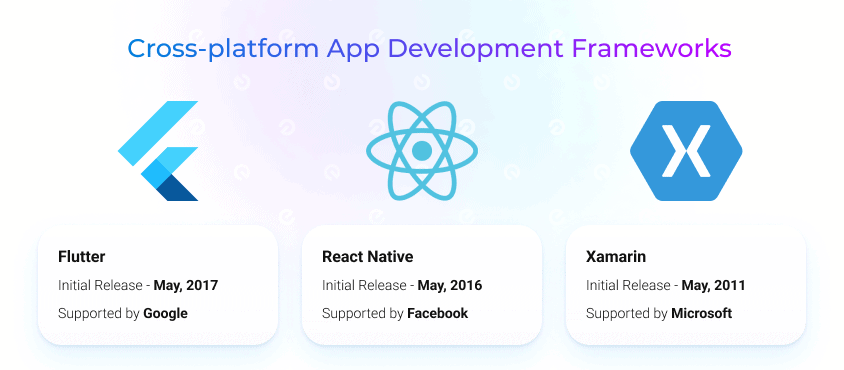
  • Examples commonly listed in this category include Flutter, React Native, Electron, Tauri Ionic, Xamarin, .NET MAUI, Kotlin Multiplatform, NativeScript, and similar tools. [0h2ez2] [n674tv] [cr24aa] [jarf1d]
  • The practical promise is “develop once and deploy everywhere,” though the degree of code sharing varies by framework. [dx75ki] [jarf1d]
  • This sense is the one most likely to matter to founders choosing between speed, cost, performance, and platform-specific polish. [0h2ez2] [dx75ki]

Etymology and Origin

  • The phrase is a transparent compound of cross-platform and framework, and the sources here use it descriptively rather than attributing it to a single identifiable coiner. [0h2ez2] [n674tv] [jarf1d]
  • The vocabulary migrated into product and startup usage as mobile development and multi-OS software stacks made portability a strategic concern, with modern docs framing cross-platform frameworks as tools for reusing code across Android, iOS, and other targets. [n674tv] [dx75ki] [jarf1d]
  • Current usage is now established in mainstream developer and product literature, where it names a category of tools rather than a specific invention. [0h2ez2] [n674tv] [j1nd2z]

Adjacent Vocabulary

  • Synonyms
  • Cross-platform app framework — a narrower phrase emphasizing apps rather than general software. [n674tv] [dx75ki]
  • Cross-platform development framework — near-equivalent, slightly more process-focused. [n674tv]
  • Multiplatform framework — often used in Kotlin/JetBrains contexts; may imply stronger emphasis on shared code architecture. [jarf1d]
  • Hybrid framework — sometimes used loosely for cross-platform mobile tools, but it can also imply webview-based apps, so the match is imperfect. [0h2ez2] [dx75ki]
  • Antonyms
  • Native development — separate codebases for each OS. [0h2ez2] [dx75ki]
  • Platform-specific framework — optimized for one ecosystem only.
  • Single-platform app — intentionally limited to one operating system or device class.

Usage in Practice

  • “Cross-platform app development frameworks let you use the same codebase for multiple platforms.” [n674tv]
  • “Cross-platform development uses a single codebase to build apps for both iOS and Android.” [dx75ki]
  • “In cross-platform apps, some or even all of the source code can be shared.” [jarf1d]
  • “This means that developers can create and deploy mobile assets that work on both Android and iOS without having to recode them for each individual platform.” [jarf1d]
  • “Build complete cross-platform products with Qt Framework Framework’s comprehensive set of libraries and APIs.” [j1nd2z]
  • “Flutter is an open-source software development kit … mainly used for cross-platform mobile app development.” [0h2ez2]
  • “Cross-platform frameworks allow you to write shareable and reusable code.” [jarf1d]

Common Misuses

  • Calling every mobile toolkit a “cross-platform framework” when it is actually a native SDK or platform-specific library; the better term is native development stack. [0h2ez2] [dx75ki]
  • Using cross-platform to mean only “runs on Android and iOS” when the product also targets desktop or web; the better term is multiplatform framework or cross-platform software framework. [n674tv] [j1nd2z] [jarf1d]
  • Using hybrid app as a catch-all synonym for any cross-platform tool, even when the framework shares substantial native code; the better term is cross-platform mobile framework. [0h2ez2] [dx75ki]
  • Treating cross-platform framework as a business-model or operating-model concept; the better term is management framework, go-to-market framework, or operating model.

Sources