


CRISPR
Defining and Describing CRISPR

CRISPR is a programmable genome-editing platform—originally a bacterial immune system—that startups now treat as a foundational technology stack for building gene therapies, engineered crops, diagnostics, and research tools.[1][4]
In innovation and startup contexts, CRISPR almost always refers to CRISPR–Cas gene-editing systems (Cas9, Cas12, Cas13, base editing, prime editing), not just the natural DNA repeats in bacteria.[1][2][4] It applies when you are talking about programmable, guide-RNA-directed editing or regulation of DNA/RNA for therapeutic, agricultural, manufacturing, or tool-building purposes.[1][2][4] It does not apply to older editing methods like zinc-finger nucleases or TALENs, nor to generic “genomics” or sequencing without active editing.[1][4] Innovation consultants care because CRISPR unlocks new categories—one-shot cures, modular biological “software,” and IP-heavy platforms—and reshapes market structure, regulatory risk, and business-model design across biotech and beyond.[1][2][6][8]
Disambiguation
Primary sense — the innovation-consulting sense
Tight definition
In innovation work, CRISPR means the suite of CRISPR–Cas gene-editing and gene-regulation technologies (Cas9, Cas12, Cas13, base editors, prime editors, CRISPRi/a) used as a programmable platform for designing biological products and therapies.[1][2][4][7]
Scope, usage, and boundaries
- CRISPR–Cas systems provide “precise and programmable tools to modify the genome and transcriptome,” enabling targeted knockout, correction, or insertion of genes via guide RNA–directed nucleases like Cas9.[1]
- The toolbox now includes base editing and prime editing for single-nucleotide precision without double-strand breaks, plus CRISPRi/a for transcriptional repression/activation and Cas13 systems for RNA editing—broadening use cases from permanent edits to reversible modulation.[1][2][5]
- Commercial and translational usage spans human therapeutics, agriculture and plants, animal health, biomanufacturing, and research tools, with institutions like the Broad Institute explicitly licensing CRISPR IP across these fields.[2][4][6][8]
- CRISPR is not a synonym for “any gene editing”: older tools like zinc-finger nucleases and TALENs are distinct technical platforms with different IP, cost structures, and design complexity; “CRISPR” should be reserved for CRISPR–Cas–based systems.[4]
Other senses
- Also used in basic microbiology to refer narrowly to the clustered DNA repeats in bacterial genomes (the original CRISPR loci) without implying any engineered editing toolkit; this sense is usually not relevant in innovation or commercialization contexts.[1]
Etymology and Origin
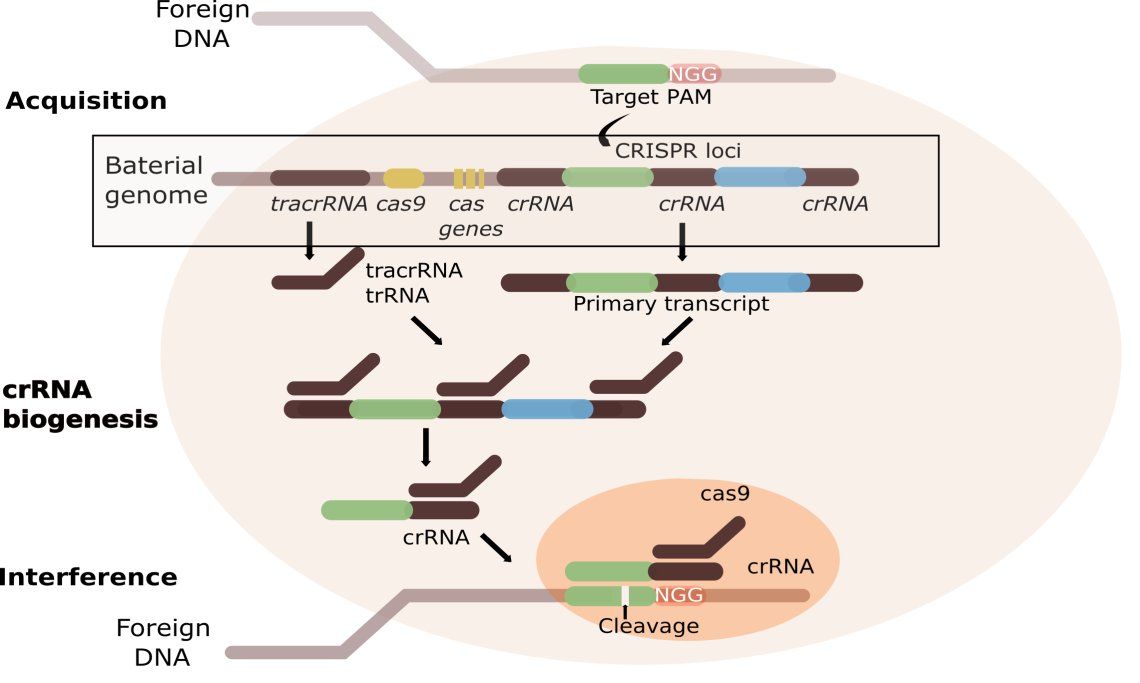
- Biological origin. CRISPR is an acronym for “clustered regularly interspaced short palindromic repeats,” describing repeating DNA sequences found in bacteria and archaea that form part of an adaptive immune system against viruses.[1]
- Mechanistic understanding. This natural CRISPR–Cas system was characterized as a three-stage immune process—adaptation, expression, interference—where Cas proteins, guided by RNA derived from these repeats, recognize and cut invading genetic elements.[1]
- Repurposing as a tool. The breakthrough that turned CRISPR into an engineering platform came when Jennifer Doudna and Emmanuelle Charpentier showed that Cas9 can be programmed with a synthetic single-guide RNA (sgRNA) to target specific DNA sequences, “lay[ing] the foundation for programmable genome modifications” in many organisms.[1]
- Expansion of the concept. Subsequent work generalized the term “CRISPR” in practice to encompass newly engineered variants—catalytically inactive dCas9 for CRISPRi/a, base editors, prime editors, and RNA-targeting systems like Cas13—which today are all commonly lumped under the CRISPR umbrella in business and startup discourse.[1][5]
Adjacent Vocabulary
Synonyms
- CRISPR–Cas9 gene editing – Often used interchangeably with “CRISPR,” but technically refers to the Cas9-based system; many newer tools (Cas12, Cas13, base editing, prime editing) extend beyond Cas9.[1][2][4]
- Programmable genome editing – Emphasizes the guide-RNA programmability shared by CRISPR tools; slightly broader but in practice usually points to CRISPR rather than older nucleases.[1][4]
- CRISPR-based gene editing – Industry/market term for the entire segment of products and services built on CRISPR platforms.[8]
Antonyms
- Non-programmable / random mutagenesis – Conventional breeding or chemical/radiation mutagenesis without targeted control; used in contrast to CRISPR’s precision in plant and animal applications.[4]
- Conventional therapeutics – Small molecules or biologics that modulate pathways without editing the genome; contrasted with CRISPR-based gene therapies in biotech strategy and market reports.[6][8]
Adjacent terms
- Gene Therapy – Many CRISPR startups pursue in vivo or ex vivo gene therapies for monogenic and complex diseases.[1][6][8]
- Base editing – A CRISPR-derived modality enabling precise base changes without double-strand breaks.[1][2]
- Prime editing – Another CRISPR-derived approach that uses Cas9 nickase fused to reverse transcriptase for precise insertions/deletions.[1][2]
- Platform biotech – Many CRISPR ventures position themselves as platform companies, licensing their editing stack across multiple indications or verticals.[2][6][8]
- Biomanufacturing – CRISPR is increasingly used to engineer cell lines and organisms for industrial production of biologics and other molecules.[2][4][6]
Usage in Practice
- A review in Nature Reviews Neurology notes that “The CRISPR–Cas9 system has revolutionized genome editing due to its high precision and programmability,” highlighting its impact on how researchers and companies approach genetic disease.[1]
- The same review emphasizes the startup-relevant therapeutic angle: “CRISPR–Cas platforms can correct pathogenic mutations, suppress toxic gene expression, and restore neuronal function,” pointing to neurodegenerative disease programs as a key application area.[1]
- The Broad Institute, describing its licensing strategy, frames CRISPR as a broadly applicable technology stack: it licenses “gene editing technologies — including CRISPR-Cas9, Cas12, Cas13, base editing, and prime editing — broadly” across internal research, agriculture, animal health, manufacturing, and bioproduction.[2]
- A CRISPR market analysis projects that the CRISPR market was about USD 4.6 billion in 2025 and may grow to USD 19.3 billion by 2035, underscoring how investors and executives now model CRISPR as a distinct, fast-growing technology market.[6]
- An industry report on CRISPR-based gene editing similarly estimates a global market of USD 4.01 billion in 2024, expected to reach USD 13.50 billion by 2033, reinforcing the perception of CRISPR as a long-term growth platform rather than a niche lab technique.[8]
- A technical overview of CRISPR delivery methods frames operational constraints for startups: “CRISPR delivery vehicles fall into three categories: viral, non-viral, and physical,” and emphasizes that delivery choice affects whether Cas nucleases can be packaged and how efficiently cells can be edited—core design decisions for product teams.[7]
- A therapeutic analysis of CRISPR-Cas3 describes it as a “new platform for genome-editing therapies, addressing limitations associated with CRISPR-Cas9,” showing how even within the CRISPR ecosystem, founders pitch newer Cas systems as platform upgrades.[5]
Common Misuses
- Using “CRISPR” to mean any gene-editing method. People sometimes label zinc-finger or TALEN-based approaches as “CRISPR,” obscuring differences in IP, cost, and ease of design; the better term is “gene editing” or the specific platform name (e.g., TALEN-based editing).[4]
- Equating CRISPR strictly with Cas9. Marketing copy often treats CRISPR and Cas9 as identical, ignoring CRISPRi/a, base editing, prime editing, Cas12, Cas13, and Cas3; when referring to the broader toolset, “CRISPR–Cas technologies” or “CRISPR-based platforms” is more accurate.[1][2][5]
- Calling all CRISPR therapies “germline editing.” Public discourse and some pitches conflate somatic gene therapies with ethically restricted germline edits; the precise term for current clinical programs is “somatic CRISPR-based gene therapy”, while “germline editing” should be reserved for heritable modifications, which major licensors explicitly do not permit.[2]
- Using “CRISPR” as a generic synonym for genomics or sequencing. Some innovation narratives talk about “CRISPR data” or “CRISPR analytics” when they mean genomic data or sequencing platforms; the correct high-level term here is “genomics” or “next-generation sequencing”, not CRISPR, unless active editing is involved.[1][4][8]
Sources
[1]: CRISPR–Cas technologies in neurodegenerative disorders - PMC
[2]: Licensing gene editing systems - Broad Institute
[3]: Implications of CRISPR Dispute on Licensees | Crowell & Moring LLP
[4]: [PDF] CRISPR Technology 2025: Patent & License landscape on Plants
[5]: CRISPR-Cas3: a potential therapeutic approach for genetic disorders?
[6]: CRISPR Market | Global Market Analysis Report - 2035
[7]: CRISPR Delivery Methods: Cargo, Vehicles, and Challenges
[8]: CRISPR-based Gene Editing Market | Industry Report, 2033