


Core Web Vitals
Defining and Describing Core Web Vitals
- The standard set originally consisted of
- Largest Contentful Paint (LCP),
- First Input Delay (FID), and
- Cumulative Layout Shift (CLS), and later guidance and tooling also include
flowchart TD
A["Core Web Vitals"] --> B["Loading performance"]
A --> C["Interactivity"]
A --> D["Visual stability"]
B --> E["Largest Contentful Paint"]
C --> F["First Input Delay"]
C --> G["Interaction to Next Paint"]
D --> H["Cumulative Layout Shift"]
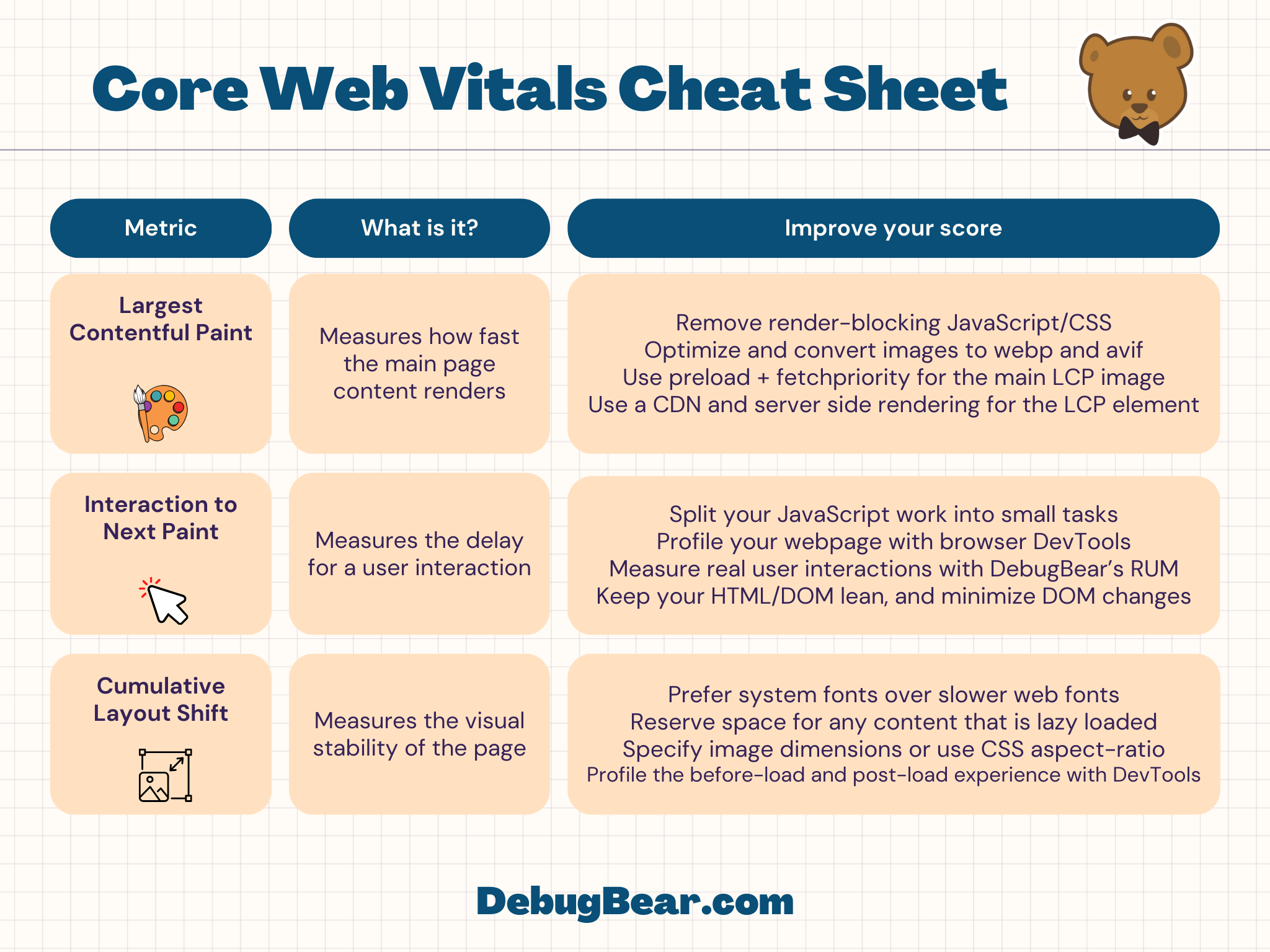
Uses in Context
- In analytics dashboards, Core Web Vitals are used to “pinpoint which elements in a web page are affecting the user's experience” in visual form. [3u6q1b]
- In optimization guides, they are described as metrics that help improve “loading performance, interactivity, and visual stability” to retain users and drive conversions. [t9mvm9]
- In enterprise accessibility and performance programs, Core Web Vitals are combined with WCAG checks to manage both UX and compliance risk in one system. [32opo1]
History of Use
Origins
- The term is associated with Google’s Web Vitals initiative, which Addy Osmani says was officially launched in May 2020 as “a new program… to provide unified guidance for quality signals that are essential to delivering a great user experience on the web.” [hx6if4]
- Osmani’s history places the work inside Google beginning in 2014, with Core Web Vitals emerging as “the first and most important” metrics in that initiative. [hx6if4]
- The initial core set was a shortlist of metrics focused on “the core aspects of user experience that apply to all web pages.” [hx6if4]
Evolution
- 2014–2020: The concept matured from internal performance research into a standardized web-quality program at Google, culminating in the Web Vitals launch and the Core Web Vitals shortlist. [hx6if4]
Best Real-World Examples
- Cloudflare Web Analytics — surfaces Core Web Vitals visually so site owners can identify page elements affecting experience. [3u6q1b]
- Google PageSpeed Insights — commonly used to inspect LCP, INP, and CLS performance on pages. [t9mvm9]
- Google Search Console — used for ongoing Core Web Vitals monitoring with real Chrome user data. [9mvgf3]
- Google Lighthouse — used in build and audit workflows to test Core Web Vitals alongside accessibility. [32opo1]
Case Studies
A practical example of Core Web Vitals in use is Cloudflare Web Analytics, which presents the metrics as a visual diagnostic tool that helps pinpoint page elements hurting experience.
[3u6q1b]
Its documentation frames Core Web Vitals as “high-level metrics designed by Google,” and it lists the three classic measures—LCP, FID, and CLS—along with ratings such as Good, Needs Improvement, or Poor.
[3u6q1b]
This shows how the concept moved from abstract performance theory into operational dashboards that let teams inspect page components and prioritize fixes.
[3u6q1b]
Another example is the optimization workflow described by Adobe, which treats Core Web Vitals as standardized measures of loading, interactivity, and stability and explicitly says they were “Introduced in 2020.”
[t9mvm9]
In that framing, LCP, INP, and CLS become the working triad for improving user experience and conversion outcomes, which reflects how the concept expanded from measurement into business optimization practice.
[t9mvm9]
A third example is the enterprise approach described by Siteimprove, which recommends combining Core Web Vitals with WCAG checks and integrating both into the same build-and-backlog process.
[32opo1]
The article says tools such as Google Lighthouse can test both accessibility and Core Web Vitals for every deployment, while RUM tools capture real-world data across devices and regions.
[32opo1]
That case shows Core Web Vitals functioning not as a standalone metric set, but as part of a broader product-quality system that connects engineering, UX, and governance.
[32opo1]