


Context Rot
(2025-08-17T02:04.922Z)
Perplexity Query
(2025-08-17T02:04
.922Z)
Question:
Write a comprehensive one-page article about "Context Rot".
Response from sonar-pro:
Introduction
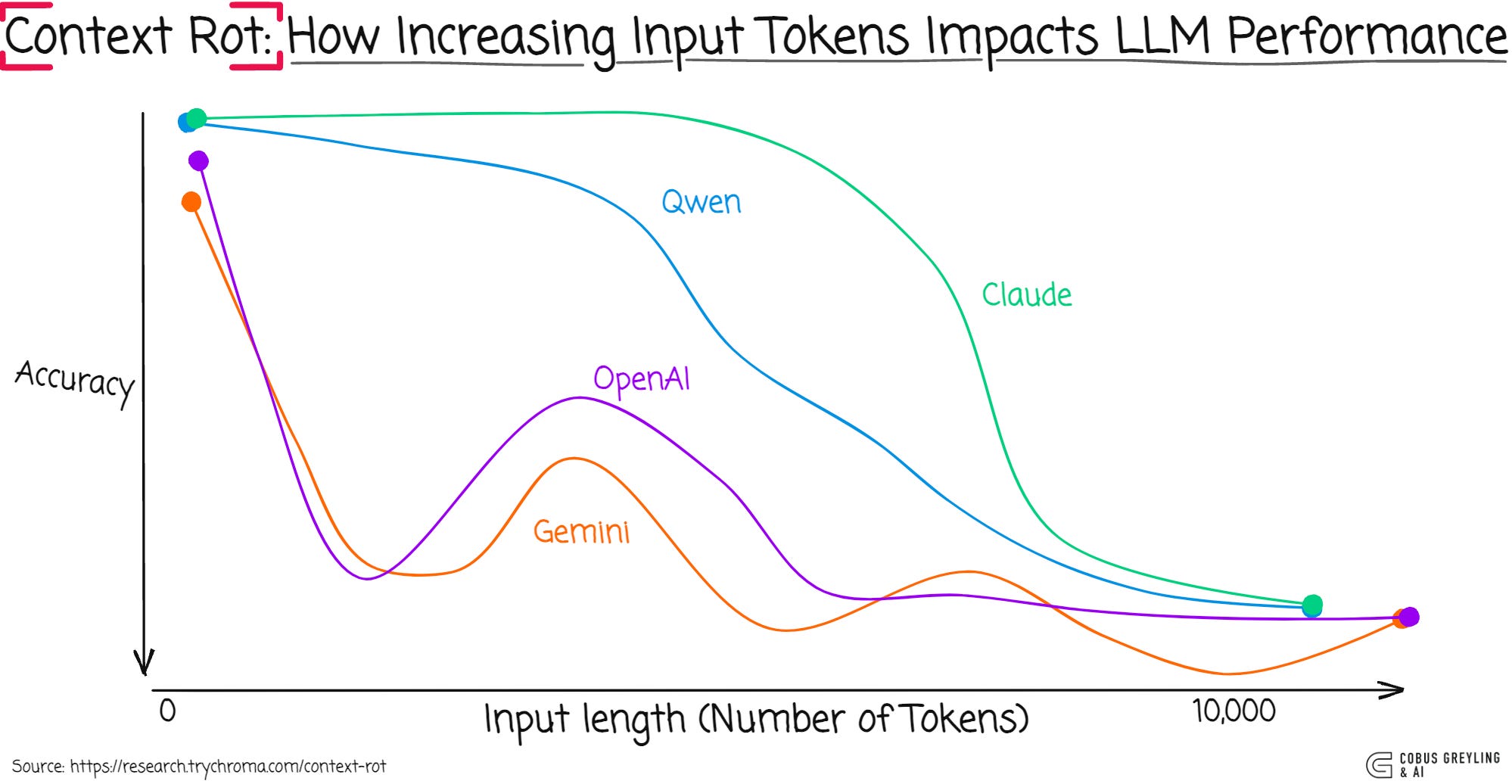
Context Rot refers to the degradation of output quality in AI Models, especially large language models (LLMs), as their Context Window—the information provided to them—grows cluttered with irrelevant, outdated, or distracting data.
[wfmn3s]
[8oulfh]
[2us5i9]
This phenomenon is significant because modern AI systems increasingly rely on vast context windows to maintain coherence in long conversations, process multi-document tasks, or perform complex code generation.
[0rsxvk]
[8oulfh]
Understanding and mitigating context rot is crucial for keeping AI systems accurate, responsive, and dependable as their use scales.

Keep the Main Thing the Main Thing
LLMs face a significant "context problem" known as context rot, where performance degrades as input length increases, despite larger, technically available context windows. Even with massive capacities, models often suffer from "lost-in-the-middle" recall issues, struggling to utilize information placed in the middle of long prompts, leading to 30%+ accuracy drops.
[ug6nvj]
[tff7ac]
[zr4ef0]
[8mmb20]
At its core, context rot emerges when longer context windows accumulate noise: failed attempts, debugging detours, irrelevant tangents, and low-quality information.
[wfmn3s]
[2us5i9]
In the initial stage of a session, a model provided with well-structured, pertinent context performs reliably—answering questions, generating code, or summarizing documents with precision. However, as the session proceeds, new information continually piles up. Instead of storing only what's necessary, the context window retains everything: successful outputs mixed with mistakes, dead ends, and off-topic exchanges.
[wfmn3s]
[2us5i9]
This makes it increasingly difficult for the model to distinguish relevant from historical or irrelevant data, resulting in inaccurate, confused, or “hallucinated” outputs.
[8oulfh]
[2us5i9]
^a72306
For example, during extended code review or debugging sessions, an AI coding assistant might initially generate helpful suggestions. As the conversation turns into a complex dialogue with many failed fixes and contradictory ideas, the model’s productivity drops. It may reference earlier incorrect fixes, overlook critical new requirements, or misinterpret the developer’s intentions—creating buggy code that risks production outages.
[0rsxvk]
[xu0t6z]
Similarly, in multi-document research tasks, LLMs show higher accuracy retrieving details from the start or end of a context window, but information in the middle often gets lost—a concrete manifestation of context rot.
[2us5i9]
The main benefit of understanding context rot lies in designing effective workflows and tools for AI-powered tasks. By actively managing context—trimming unnecessary details, prioritizing salient information, and organizing context windows—developers and users can preserve model performance over time.
[wfmn3s]
[8oulfh]
Technologies like context engines, which use indexing, causal analysis, and persistent memory, are emerging to address these issues directly.
[0rsxvk]
These systems help AI models “think” more like senior engineers, remembering the right details, not just more details.
Key Factors
• Context Rot & Degradation: As input tokens increase, the model’s ability to recall information accurately decreases. Models frequently fail to process context uniformly, behaving worse as they get closer to their context limit.
• Lost-in-the-Middle Phenomenon: Studies show models attend well to the beginning and end of a prompt but struggle to retrieve relevant information buried in the middle.
• Attention Dilution: Because of the transformer architecture, every token relates to every other token. A larger context "dilutes" the model's attention budget, making it harder to focus on critical information.
• Distractor Interference: Similar, irrelevant content ("distractors") within the context can significantly mislead the model, compounding accuracy loss beyond simple token volume.
• Performance Inconsistency: While models might handle simple retrieval well, they struggle with complex, long-context reasoning, often failing on tasks requiring the analysis of large amounts of data.
[ug6nvj]
[zr4ef0]
[3dyv03]
[iwbn1r]
However, context rot comes with challenges. Excessive trimming risks losing essential data, while insufficient pruning causes rot. Different models deteriorate at different rates and with different types of distractions.
[8oulfh]
[2us5i9]
Semantic noise (meaningless or conflicting information) is more damaging than mere length. There is no one-size-fits-all strategy—context engineering must be tailored to the specific workflow and model capabilities.
Current State and Trends
Recent research, such as ChromaDB Research’s technical report and experiments, has spotlighted context rot as a real and measurable problem for the latest LLMs.
[8oulfh]
[2us5i9]
[xu0t6z]
Tests demonstrate that performance degradation grows non-linearly with input size, and models consistently struggle more with semantic reasoning amid distractors.
[8oulfh]
[xu0t6z]
Companies like Augment Code are developing new solutions (e.g., context lineage tracking) to ensure that only the most relevant information persists through long coding or chat sessions.
[0rsxvk]
The market is responding quickly: context engineering—a discipline focused on feeding models just the right data—has become critical as prompt engineering once was.
[wfmn3s]
[8oulfh]
Key players are building smarter context management tools, persistent chat histories, and context-aware agents to combat rot. Technologies enabling real-time context indexing, memory management, and relevance scoring are being rapidly integrated into popular developer tools and AI platforms.
[0rsxvk]
[8oulfh]
Recent advances also target model architectures themselves. Developers and researchers are experimenting with mechanisms for context prioritization, segmenting conversations, and explicitly marking instructions or key information to help maintain clarity despite length or noise.
[wfmn3s]
[2us5i9]
Why This Matters:
Without precise management, this creates limitations for AI agents using long documents or extensive conversation histories. The problem forces developers to use techniques like Retrieval Augmented Generation (RAG) to only send pertinent information rather than feeding the entire context to the model.Effective context engineering, such as carefully placing crucial information at the start or end, is necessary to mitigate these issues until architectural improvements are made.
[ug6nvj]
[07ne3u]
[cg2jxk]
[cge9jy]
[ey94pn]
Citations
[0rsxvk] 2025, Jul 30.
. Published: 2025-07-29 | Updated: 2025-07-30[wfmn3s] 2025, Jul 18. Context Engineering: Bringing Engineering Discipline to .... Published: 2025-07-18 | Updated: 2025-07-18
[8oulfh] 2025, Jul 29. Context Rot: How LLMs Degrade with Longer Context Windows. Published: 2025-07-28 | Updated: 2025-07-29
[2us5i9] 2025, Aug 13. Context Rot, or Too Much of a Good Thing - by MB Crosier. Published: 2025-08-06 | Updated: 2025-08-13
[xu0t6z] 2025, Jul 23.
. Published: 2025-07-22 | Updated: 2025-07-23