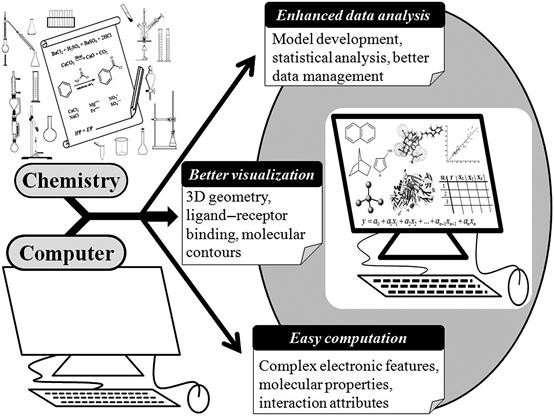
Computational Chemistry
https://oscars-project.eu/projects/iochem-bd-open-data-computational-chemistry-and-materials-science
Defining and Describing Computational Chemistry

Computational chemistry is the use of mathematical models and computer simulations to study, predict, and optimize the behavior of molecules and materials, increasingly forming the predictive “engine room” of modern chemistry-heavy startups and R&D organizations.
[coo48h]
[it3xsj]
In strict scientific terms, computational chemistry is a branch of chemistry that “employs mathematical models and computer programs to analyze chemical systems” and “uses computer simulations to assist in solving chemical problems.”
[coo48h]
[it3xsj]
It applies when you are using algorithms—ranging from quantum mechanics to molecular dynamics and machine learning—to design or understand molecules, reactions, or materials before (or alongside) lab experiments.
[coo48h]
[it3xsj]
[jxy4pj]
It does not cover generic data dashboards or LIMS tools that merely track lab results; the core is physics- or data-based modeling of chemical behavior to generate new predictions.
[coo48h]
[it3xsj]
An innovation consultant cares because computational chemistry often determines the feasibility, timelines, capital needs, defensibility, and platform potential of startups in areas like drug discovery, battery materials, carbon capture, and industrial catalysts.
[coo48h]
[it3xsj]
Disambiguation
Primary sense — the innovation-consulting sense
Computational chemistry (innovation sense): the use of computer-based molecular and materials modeling as a core capability for discovering, optimizing, and de‑risking chemical products and processes in R&D-heavy businesses.
- In the scientific definition, computational chemistry “employs mathematical models and computer programs to analyze chemical systems” and “uses computer simulations to assist in solving chemical problems,” which in industry becomes a capability to predict reaction outcomes, binding affinities, or material properties before extensive wet-lab work. [coo48h] [it3xsj]
- It spans methods from ab initio quantum mechanics and density functional theory (DFT) to molecular mechanics, molecular dynamics, and higher-level modeling of reaction networks and materials properties. [it3xsj] [jxy4pj] For an innovation context, the important distinction is that these methods can systematically trade off accuracy versus speed and cost, shaping the startup’s experimentation economics. [it3xsj] [jxy4pj]
Other senses
There are no major alternate senses of “computational chemistry” outside this scientific/technical meaning; the term is consistently used for computer-based modeling of chemical systems in research, education, and industry.
[coo48h]
[0r44uz]
[it3xsj]
Etymology and Origin
- The term “computational chemistry” emerged as digital computers became available for quantum-chemical and molecular calculations in the mid‑20th century, with the field described as having “emerged mid‑20th century alongside first digital computers” and becoming “commonplace in chemical research by the late 20th century.” [coo48h]
- A widely cited early formalization of the field’s scope is the textbook Computational Chemistry by Errol Lewars (first edition 2003), building on decades of prior work in quantum chemistry and molecular modeling; Wikipedia summarizes the field succinctly as “a branch of chemistry that uses computer simulations to assist in solving chemical problems.” [it3xsj]
- The field’s importance was cemented into the broader scientific and industrial vocabulary via Nobel Prizes: for example, the 1998 Nobel Prize in Chemistry to Walter Kohn (development of density functional theory) and John Pople (computational methods in quantum chemistry), and later prizes recognizing multiscale models and complex simulations—one teaching source notes that “over the last 30 years, three Nobel prizes have been awarded to breakthroughs in computational chemistry.” [coo48h]
- From the 1990s onward, as processing power expanded, computational chemistry migrated from specialist academic groups into pharmaceutical, materials, and chemical-process companies, and is now described as appearing “in virtually all areas of modern chemical research,” which is the backdrop for its adoption by deep‑tech startups. [coo48h]
Adjacent Vocabulary
- Synonyms
- Antonyms
- Adjacent terms
- Quantum chemistry – quantum‑mechanical modeling of molecules and materials, forming a foundational subset of computational chemistry. [0pp1hq] [it3xsj]
- Molecular dynamics – simulation of atomic motion over time using classical or quantum-informed force fields, widely used in drug and materials startups. [it3xsj] [jxy4pj]
- Cheminformatics – data-centric analysis and machine learning on chemical structures and properties, increasingly integrated with computational chemistry workflows. [it3xsj] [jxy4pj]
- Drug discovery – domain where computational chemistry and virtual screening are now standard tools to identify and optimize lead compounds. [coo48h] [it3xsj]
- Materials science – field where computational chemistry predicts properties of polymers, ceramics, batteries, catalysts, and other materials. [coo48h] [it3xsj]
- High throughput screening – technique that, when virtualized, relies heavily on computational chemistry to triage candidates before physical testing. [coo48h] [it3xsj]
Usage in Practice
- An education article for practitioners notes that “computational chemistry (CC) is the branch of chemistry that employs mathematical models and computer programs to analyze chemical systems,” highlighting how simulations are now integral to research workflows. [coo48h]
- The same piece emphasizes adoption and scale: “Over the last five decades, the processing power of computers has grown exponentially, which has vastly expanded the capacity of computational methods in chemistry,” and that “now computational chemistry appears in virtually all areas of modern chemical research.” [coo48h]
- A teaching-oriented commentary from a practicing chemist describes a shift in mindset: “Computation is a different take on organic chemistry, and not just a more precise perspective on geometry and mechanisms,” underscoring that computational chemistry changes how chemists think about reactivity and mechanism, not just how they draw structures. [nsh59f]
- Schrödinger’s education-focused material notes that “the understanding of chemistry has been revolutionized in the last decade by the rise of computational chemistry (CC), which allows direct access to the energy of chemical structures,” framing CC as a way to directly probe energetics that are otherwise hard to measure. [0r44uz]
- The same source connects CC to inquiry and modern tooling: it calls computational chemistry “a powerful example of the essential role that simulations now play in exploring scientific questions,” and argues that bringing CC into the classroom “introduce[s] [students] to modern tools used in scientific research.” [0r44uz]
Common Misuses
- Calling any chemical data analysis “computational chemistry.”Many teams label basic statistical analysis or generic machine-learning on assay data as computational chemistry, but if no underlying molecular or materials modeling is involved, cheminformatics or data analysis of chemical experiments is more accurate. [it3xsj] [jxy4pj]
- Equating vendor software usage with a differentiated computational chemistry capability.Simply running commercial packages (e.g., for docking or DFT) without in‑house expertise is often advertised as a strong CC capability; in innovation contexts this is closer to software-enabled chemistry or outsourced modeling than to a true computational chemistry core. [nsh59f] [it3xsj]
- Using “computational chemistry” when the work is purely quantum theory development.Some theoretical-physics or quantum-chemistry groups developing new analytic methods without large-scale simulations are better described as doing theoretical chemistry or quantum chemistry theory rather than applied computational chemistry. [0pp1hq] [it3xsj]