


Compound Annual Growth Rate
Defining and Describing Compound Annual Growth Rate
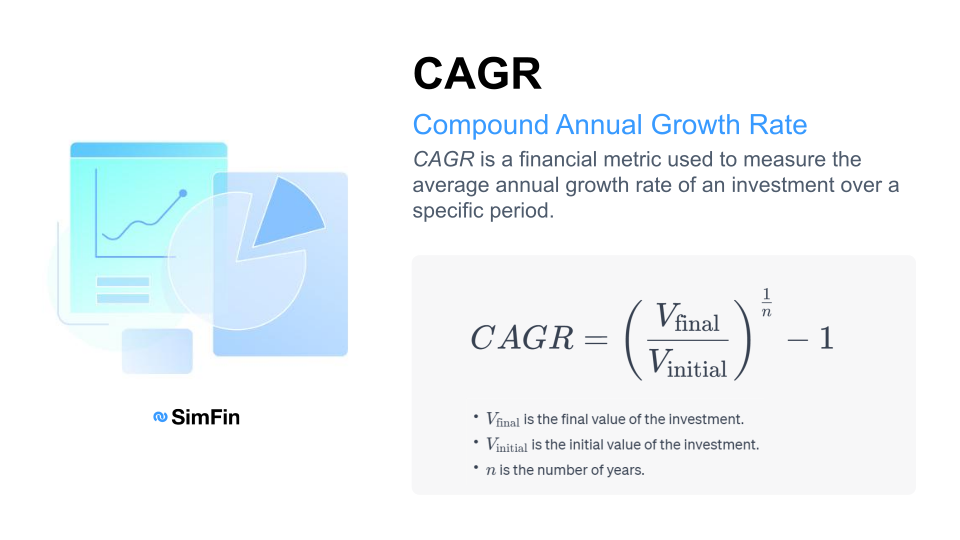
Compound Annual Growth Rate turns a bumpy, year‑by‑year path into one clean number that answers “what steady yearly rate would get me from the start to the finish?”
Compound Annual Growth Rate (CAGR) is a financial and business metric that describes the average annual growth rate of a value—such as an investment, revenue, market size, or user base—over a multi‑year period, assuming all gains are reinvested and growth is compounded annually.
[qpeqz1]
[dijz52]
[nl3cu7]
[pf5fsj]
It is calculated as the constant rate that would take a beginning value to an ending value over a specified number of years, smoothing out short‑term volatility and irregular year‑to‑year changes.
[qpeqz1]
[2kouot]
[raf6b8]
[93sgnj]
Because it summarizes long‑term performance in a single, comparable percentage, CAGR is widely used to compare investments, evaluate business performance, and describe market or product growth over time.
[2kouot]
[raf6b8]
[pf5fsj]
In many contexts it is also referred to as an annualized growth rate or geometric average growth rate.
[dijz52]
[psvi2w]
A standard mathematical definition is:
$$
\text{CAGR} = \left(\frac{\text{Ending Value}}{\text{Beginning Value}}\right)^{\frac{1}{n}} - 1
$$
where $n$ is the number of years in the period.
[qpeqz1]
[2kouot]
[nl3cu7]
[raf6b8]
[93sgnj]
[psvi2w]
Uses in Context
- Investment performance reporting and comparisonCAGR is “the average annual rate at which an investment grows over a specific period, considering all returns are reinvested,” making it easier to compare investments held for different lengths of time. [qpeqz1] [2kouot] [nl3cu7] [raf6b8] It is described as “the smoothed annualized rate of return for an investment over a given period.” [2kouot]
- Business metrics such as revenue or company growthBeyond investments, “the Compound Annual Growth Rate (CAGR) describes the average annual growth of a metric such as revenue, market size, user base, or investment over several years,” providing a simple way to show how a metric has developed without being distorted by short‑term fluctuations. [dijz52] [pf5fsj] [psvi2w]
- Market research and industry reportsMarket and industry analyses routinely report that a sector “is expected to grow at a CAGR of X%” over a forecast period, using the metric as a standardized way to express projected long‑term growth in a single rate. [dijz52] [pf5fsj] [psvi2w] Sources emphasize that CAGR “provides a standardized way to measure how fast an investment grows over time.” [raf6b8] [pf5fsj]
- Target setting and planning in corporate financeCorporations and planners use CAGR to set and communicate growth targets; one training resource notes that CAGR is useful for “tracking business performance and setting growth targets” because it gives a comparable growth rate that “ignores swings inside the period.” [2kouot] [93sgnj]
- Communicating long‑term trends to non‑expertsBecause CAGR “summarizes the total growth over the period and converts it into an average annual growth rate, as if the value had increased evenly every year,” it is often used in presentations and reports to communicate complex, volatile histories as one understandable figure. [dijz52] [2kouot] [pf5fsj]
- Comparing strategies or managers over multi‑year horizonsInvestment articles highlight that “compound annual growth rate is one of the most widely used metrics in long-term performance analysis” because it allows investors to compare different funds, strategies, or portfolios on a like‑for‑like, annualized basis. [raf6b8] [pf5fsj]
History of Use
Origins
- Modern references describe CAGR as “also known as the Annualized Growth Rate or Geometric Average Growth Rate,” explicitly linking it to the geometric mean used in earlier finance and actuarial work. [dijz52]
- While widely used in contemporary investment and business education, publicly accessible sources and glossaries (for example, the U.S. SEC’s Investor.gov entry defining CAGR) treat it as a standard descriptive term rather than attributing it to a specific originator or single foundational paper. [adr8us]
Given available sources, CAGR is best understood as a practitioner term emerging from long‑standing geometric‑mean return calculations, not as a branded concept introduced by a single firm or academic.
Evolution
- Late 20th century – adoption in retail investing and fund marketingAs mutual funds and managed products became more common, industry and regulators encouraged using annualized, geometric‑mean returns to present long‑term performance in a standardized way; sources now describe CAGR as “one of the most widely used metrics in long-term performance analysis” for investments. [raf6b8] [pf5fsj] [adr8us]
- 2000s–2010s – generalization beyond investmentsBusiness and consulting education material began explicitly applying CAGR to “revenue, market size, user base, or investment over several years,” positioning it as a general tool for describing any compounding metric over time rather than only financial assets. [dijz52] [pf5fsj] [psvi2w]
- Recent practice – embedded in tools and dashboardsContemporary guides emphasize how to implement the CAGR formula directly in Excel or code—“
CAGR = (Ending Value / Beginning Value) ^ (1 / Number of Years) - 1”—and note the availability of online CAGR calculators that return not only the number but also charts. [2kouot] [93sgnj] This reflects its integration into analytics software and self‑service financial tools.
Best Real-World Examples
- Vanguard S&P 500 Index Fund – Long‑term fact sheets typically show 5‑, 10‑, and since‑inception annualized returns, which are calculated using the same compounding formula as CAGR to communicate performance to retail investors. [2kouot] [raf6b8] [adr8us]
- Morningstar Fund Reports – Independent fund research reports present multi‑year “average annual total returns” based on geometric compounding, effectively giving investors the fund’s CAGR over standard horizons. [raf6b8] [adr8us]
- Global smartphone market analyses by Counterpoint Research – Sector reports describe the smartphone market or subsegments growing at “a CAGR of X%” over a forecast window, using CAGR to summarize expected multi‑year volume or revenue increases. [dijz52] [pf5fsj] [psvi2w]
- SaaS startup growth dashboards (e.g., Baremetrics) – Subscription‑analytics tools report metrics like Monthly Recurring Revenue over time and often derive annualized growth rates using CAGR logic to help founders understand and benchmark their growth trajectories. [dijz52] [pf5fsj]
- World Bank and IMF economic indicators – International organizations publish indicators such as GDP per capita and sometimes report “average annual growth” over decades using the compound growth formula equivalent to CAGR to compare countries’ long‑term economic performance. [dijz52] [psvi2w]
- Equity research reports by boutique investment firms – Analyst notes on high‑growth companies regularly state that revenue “grew at a CAGR of Y% over FY2018–FY2023,” using CAGR to characterize the firm’s historical expansion despite quarterly volatility. [dijz52] [pf5fsj] [psvi2w]
Case Studies

Case Study 1 – A SaaS startup clarifies its true growth path
A small SaaS startup noticed that its annual revenue had grown from $500,000 to $2.5 million over five years, with large fluctuations year to year due to product launches and customer churn.
[dijz52]
[pf5fsj]
Some years showed 60%+ growth and others nearly flat performance, making it hard for investors to interpret the trajectory from raw year‑over‑year percentages.
[pf5fsj]
By applying the standard formula $\text{CAGR} = (\text{Ending Value} / \text{Beginning Value})^{1/n} - 1$, the founders computed a CAGR of about 37% per year, representing the constant annual rate that would take $500,000 to $2.5 million in five years.
[2kouot]
[raf6b8]
[93sgnj]
[psvi2w]
When they presented this single CAGR figure alongside the volatile annual numbers, investors immediately saw that the business had delivered strong, sustained growth over the period, even though individual years were uneven.
[2kouot]
[raf6b8]
[pf5fsj]
This case illustrates how CAGR “smooths out fluctuations by assuming the investment grew at a steady pace each year” and provides a standardized way to compare performance with other startups or benchmarks.
[raf6b8]
[pf5fsj]
[93sgnj]
Case Study 2 – Comparing two investment strategies over a decade
An individual investor wanted to evaluate whether her actively managed fund had truly outperformed a low‑cost index ETF over a 10‑year period.
[2kouot]
[nl3cu7]
[raf6b8]
The active fund had spectacular gains in some years and losses in others, whereas the index ETF delivered more modest but consistent annual returns.
[2kouot]
[raf6b8]
Using only arithmetic averages of yearly returns suggested similar performance, but this simple averaging ignores compounding and volatility.
[dijz52]
[raf6b8]
[pf5fsj]
By instead calculating the CAGR for each strategy using the formula $(\text{Ending Value} / \text{Beginning Value})^{1/10} - 1$, she found that the ETF had a slightly higher compound annual growth rate despite the active fund’s occasional big wins.
[2kouot]
[nl3cu7]
[raf6b8]
[psvi2w]
As one guide explains, “compound annual growth rate is the smoothed annualized rate of return that takes an investment from its beginning value to its ending value over a given time period,” showing “the equivalent steady rate at which your money… would have needed to grow each year to reach the final result.”
[2kouot]
[raf6b8]
The investor concluded that the supposedly superior active strategy had not delivered a better long‑term compounded outcome, highlighting how CAGR can overturn impressions formed from headline yearly returns.
Case Study 3 – Market sizing in a startup pitch deck
A founding team preparing a pitch deck for a new fintech product wanted to show investors that their target market was expanding rapidly, not just large in absolute terms.
[dijz52]
[pf5fsj]
[psvi2w]
They gathered third‑party market data indicating that the segment’s total transaction volume had risen from $10 billion to $18 billion over four years.
[dijz52]
[pf5fsj]
Instead of listing raw start and end values only, they calculated the market CAGR as $(18 / 10)^{1/4} - 1$, yielding an approximate annualized growth rate that represented “how much a value grows on average per year,” as if it had increased evenly each year on a compounded basis.
[dijz52]
[2kouot]
[raf6b8]
[psvi2w]
Adding a slide stating that the market was “growing at a CAGR of roughly X% from 20XX to 20XX” aligned their pitch with the language of professional market‑research reports, which routinely express long‑term market expansion in CAGR terms.
[dijz52]
[pf5fsj]
[psvi2w]
This helped investors quickly understand both the pace and the duration of the opportunity in a single, standardized metric instead of parsing uneven year‑to‑year numbers.