


Clinical Decision Support
Defining and Describing Clinical Decision Support Systems
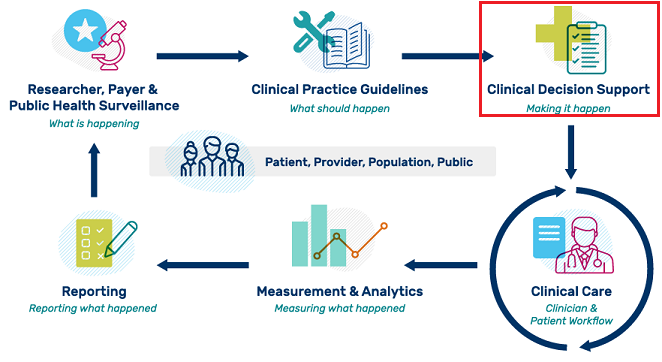
Clinical decision support systems are not a substitute for clinical judgment; they are a way to put the right information in front of clinicians at the right time.
[2bd3aa]
[0m8j6t]
Clinical decision support (CDS) is a digital tool or system that provides “timely, informed insights” and “person-specific information” to clinicians, patients, or care teams to improve patient outcomes and quality of care.
[2bd3aa]
The concept applies when a workflow benefits from real-time guidance such as alerts, reminders, order sets, diagnostic support, or guideline-based recommendations.
[2bd3aa]
It matters because well-designed CDS can reduce errors, improve efficiency, and help care teams act quickly and confidently within their normal workflow.
[2bd3aa]
[qens57]
Uses in Context
- CDS is used as a workflow aid when health systems need “information specific to the individual patient” combined with medical knowledge that can be used by computers. [2bd3aa]
- CDS is used as a documentation and ordering aid through order sets, patient data summaries, and documentation templates. [2bd3aa]
- CDS is used as a diagnostic support tool to assist clinicians in interpreting patient information and improving diagnostic accuracy. [qens57]
- CDS is used as a guideline delivery mechanism by surfacing clinical guidelines and reference materials relevant to the situation. [2bd3aa]
History of Use
Origins
Clinical decision support systems emerged from mid-20th-century healthcare computing efforts and early database-driven physician aids rather than from a single modern software product.
[qens57]
EBSCO’s overview describes CDSS as originating “in the 1950s,” when early systems relied on databases to provide physicians with treatment information, and later evolving into computerized systems and PDAs.
[qens57]
A later industry history places early CDS in the 1970s as “experimental, academic, and theoretical,” suggesting the concept matured gradually through research and implementation rather than appearing all at once as a finished category.
[9ukbru]
Evolution
- 1970s: Early CDS was “experimental, academic, and theoretical,” and it was often time-consuming, poorly integrated, and unregulated. [9ukbru]
- 1980s–1990s: CDS moved into clinical settings, where implementation became more practical and visible in day-to-day care delivery. [9ukbru]
- 2000s–2010s: CDS shifted toward evidence-based medicine, guideline-based care, smartphones, voice recognition, and automation, broadening its reach beyond desktop clinical systems. [9ukbru]
Best Real-World Examples
- ONC Clinical Decision Support — a federal reference point for CDS functions such as alerts, reminders, order sets, and diagnostic support. [2bd3aa]
- EBSCO Clinical Decision Support System — an explainer that frames CDSS as healthcare technology for assisting medical practitioners with patient-care decisions. [qens57]
- Wolters Kluwer clinical decision support solutions — a commercial example focused on reducing errors, shortening length of stay, and improving productivity. [iz7p48]
- PMC nursing-practice CDSS review — a research example showing CDS use for timely detection of deterioration, infection control, and documentation support. [2e7byx]
- PMC Indian healthcare settings CDSS article — a research example describing CDSS as HIT that assists providers in making or validating clinical decisions. [rbdc4x]
- Mindbowser CDSS examples — an applied examples piece highlighting medication safety alerts, diagnostic support, and risk scoring. [2g1q95]
- SmartHealthAsia CDSS in healthcare — an implementation-oriented example emphasizing screening reminders and evidence-based practice prompts. [h1mwi3]
Case Studies
A practical case for CDS is medication safety, where systems watch for problems such as duplicate tests or harmful drug interactions and then alert clinicians before an order is completed.
[qens57]
ONC describes CDS tools as including “computer alerts and reminders for providers and patients,” while EBSCO notes that modern systems aim to reduce medical errors by warning about “duplicate tests or harmful drug interactions.”
[2bd3aa]
[qens57]
This case shows the core logic of CDS: it does not replace the prescriber, but it makes risks visible at the point of decision.
[2bd3aa]
[0m8j6t]
Another case is guideline-based point-of-care support, where CDS surfaces order sets, clinical guidelines, reference materials, and patient-specific summaries inside the care workflow.
[2bd3aa]
ONC emphasizes that CDS information must be “clear, well-organized, and fit into the provider’s workflow” so clinicians can act quickly and confidently.
[2bd3aa]
This illustrates why CDS is more than a database: its value depends on timing, relevance, and integration with clinical work rather than on raw information alone.
[2bd3aa]
[qens57]
In nursing and inpatient settings, CDS is used to help detect clinical deterioration, support infection control, and streamline documentation.
[2e7byx]
A recent review in PMC describes these functions as practical supports for nursing practice, showing that CDS is not limited to physician decision-making.
[2e7byx]
This broader use demonstrates how the concept has expanded from physician-focused alerts into multidisciplinary care coordination and operational support.
[2e7byx]
[rbdc4x]