


Business Process Outsourcing
Defining and Describing Business Process Outsourcing
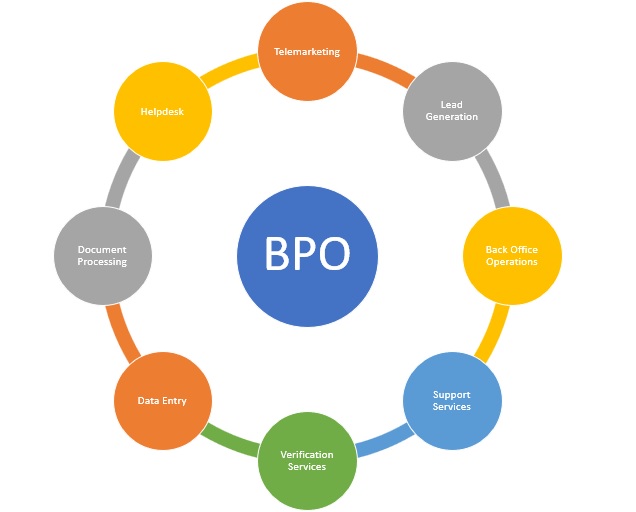
graph TD
A[Business Process Outsourcing - BPO] --> B[Front-Office e.g., Customer Support]
A --> C[Back-Office e.g., Payroll, HR]
A --> D[Offshore BPO]
A --> E[Onshore|Nearshore BPO]
B --> F[Call Centers]
C --> G[Data Entry, Accounting]
D --> H[Cost Savings via Global Providers]
E --> I[Compliance and Proximity Focus]
Business process outsourcing (BPO) empowers companies to offload non-core operations to specialized third-party providers, converting fixed costs into flexible, expertise-driven variable expenses.
[ejy2pr]
[f72kgq]
Business process outsourcing (BPO) is a subset of outsourcing in which a company contracts the operations and responsibilities of a specific business process to a third-party service provider.
[ejy2pr]
It applies to functions like payroll, HR, customer support, and data entry, allowing firms to focus on core competencies while gaining cost efficiency and scalability.
[f72kgq]
[wf7a12]
BPO matters because it transforms rigid internal processes into agile, expert-managed services, though it risks dependency and service gaps if contracts falter.
[ejy2pr]
Uses in Context
- In business strategy, BPO is invoked to delegate "non-core operations, such as payroll and HR," freeing companies for primary functions. [f72kgq]
- For cost management, it's used to "transform fixed costs into variable costs" and "leverage specialized expertise." [ejy2pr]
- In customer service, BPO describes "outsourcing some aspect of your business's operations to a third-party vendor," like call centers. [im0b8c]
- Sector analyses apply it to "pure play BPO services that focus on technology-related functions – e.g. IT, tech." [1n53x2]
- In operations, firms use BPO for "noncore tasks like payroll, support, and data entry to expert third-party providers." [wf7a12]
- For back-office efficiency, it's contracting "specific business functions" externally rather than in-house. [os6tkt]
History of Use
Origins
The term Business Process Outsourcing (BPO) emerged as a formalized subset of outsourcing in the late 1990s, building on earlier offshore data processing trends, with widespread documentation appearing in industry analyses around the early 2000s.
[ejy2pr]
It was introduced in the context of global service providers handling discrete processes like finance and administration, distinct from full IT outsourcing.
[ejy2pr]
Evolution
- Early 2000s: BPO expanded from basic Back Office tasks (e.g., Payroll) to include customer-facing front-office services like call centers, driven by telecom and internet growth. [ejy2pr] [im0b8c]
- 2010s: Integration with technology led to "technology business process outsourcing" focusing on IT-related functions, boosting industry indices. [1n53x2]
- 2020s: The sector achieved a 2025 index score of 120 (base FY19=100), reflecting post-pandemic resilience and 2-point yearly gains amid digital transformation. [1n53x2]
Best Real-World Examples
- Zendesk BPO Call Centers exemplifying customer support operations delegated to third parties. [im0b8c]
- Helpware Customer Support BPO for back-office and marketing functions outsourced globally. Helpware [8cvt7m]
Case Studies
In the HR domain, ADP has exemplified BPO by enabling employers to outsource payroll and managed HR services to third-party providers, allowing focus on core business since the early 2000s.
[f72kgq]
Companies contract ADP for these non-core operations, which handle compliance, processing, and reporting, reducing internal overhead by up to 40% in some cases through variable costing models.
[ejy2pr]
[f72kgq]
This shifted fixed HR staff costs to scalable fees, demonstrating BPO's role in agility; it shows how specialized providers mitigate talent shortages while clients report higher accuracy and compliance, though success hinges on clear service-level agreements.
[ejy2pr]
[f72kgq]
Zendesk-powered BPO call centers illustrate front-office outsourcing, where businesses delegate customer interactions to third-party vendors for 24/7 support.
[im0b8c]
Starting in the 2010s, firms like e-commerce brands outsourced via BPO providers to manage high-volume queries, integrating tools for faster resolutions and cutting costs by 30-50%.
[ejy2pr]
[im0b8c]
What changed was improved customer satisfaction scores and scalability during peaks; this case underscores BPO's value in customer-facing processes but highlights risks like unmet service levels if vendor training lags.
[ejy2pr]
[im0b8c]
The Pricewaterhouse Coopers-tracked BPO sector's evolution to a 2025 index of 120 reflects tech-focused providers adapting post-2019, with pure-play firms handling IT-BPO amid digital shifts.
[1n53x2]
Providers expanded from basic processes to AI-enhanced tech functions, improving scores through efficiency gains.
[1n53x2]
This demonstrates BPO's maturation into a resilient industry, teaching that ongoing adaptation counters challenges like changing requirements, with the 2-point annual rise signaling sustained growth.
[ejy2pr]
[1n53x2]