


Btrfs
Btrfs is intended to address the lack of pooling, snapshots, integrity checking, data scrubbing, and integral multi-device spanning in Linux file systems.[^mo6bj5] Mason, the principal Btrfs author, stated that its goal was "to let [Linux] scale for the storage that will be available. Scaling is not just about addressing the storage but also means being able to administer and to manage it with a clean interface that lets people see what's being used and makes it more reliable -- Wikipedia
Defining and Describing Btrfs
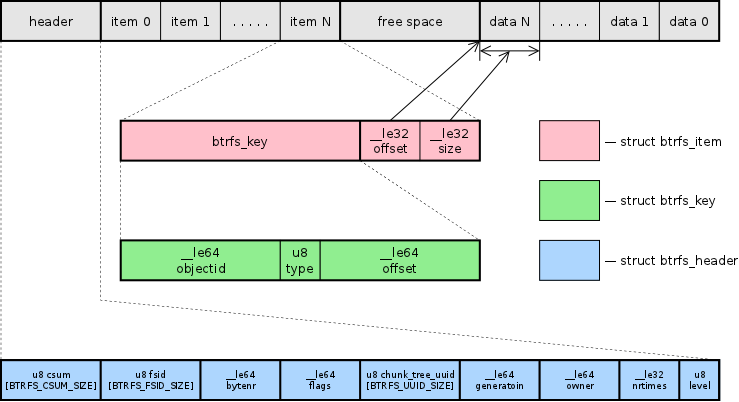
_Btrfs (short for “B‑tree file system”) is a modern Linux filesystem that startups and infrastructure teams adopt when they want built‑in snapshots, data integrity, and flexible storage management without layering multiple legacy tools.
[lw14yi]
[5kage5]
[virf6o]
Btrfs is a copy‑on‑write (CoW), B‑tree–based filesystem in the Linux kernel, designed for high scalability, fault tolerance, online repair, and advanced features like snapshots, compression, and integrated RAID‑style volume management.
[gtk5p9]
[lw14yi]
[5kage5]
[virf6o]
It applies when you are designing or operating Linux-based products, platforms, or internal infrastructure where rollback, fast cloning, storage pooling, or “cloud‑like” resilience on bare metal matter.
[gtk5p9]
[vhaf7u]
[r889if]
[virf6o]
It does not apply to application‑level data modeling or business “file systems” in the metaphorical sense; it is a low‑level storage technology choice with strategic implications for operational risk, DevOps workflows, and total cost of ownership.
[gtk5p9]
[lw14yi]
[vhaf7u]
[virf6o]
An innovation consultant would care about Btrfs when advising on technical stack choices that affect release safety (easy rollback), ops automation, backup strategy, and the ability to scale storage over time without disruptive re‑partitioning.
[gtk5p9]
[vhaf7u]
[r889if]
[virf6o]
Disambiguation
Primary sense — the innovation-consulting sense
Definition: Btrfs is a Linux copy‑on‑write filesystem with integrated volume management and snapshotting, used as a strategic storage layer in modern server, desktop, and cloud images.
[gtk5p9]
[lw14yi]
[vhaf7u]
[virf6o]
- Btrfs is “a modern copy on write (COW) file system for Linux aimed at implementing advanced features while also focusing on fault tolerance, repair and easy administration.” [virf6o] For a startup, this means fewer external tools (LVM, mdraid, separate snapshot systems) and more capabilities in the filesystem itself. [gtk5p9] [vhaf7u] [r889if] [virf6o]
- It is explicitly designed for scalability and large storage subsystems, using B‑trees to efficiently access and update large blocks of data as the filesystem grows. [gtk5p9] [lw14yi] [5kage5] This makes it relevant for data‑heavy products (analytics, media, ML, backups) where capacity, performance, and operational flexibility matter over time. [gtk5p9] [lw14yi] [r889if] [virf6o]
- Btrfs integrates logical volume management and software RAID, allowing one filesystem to span multiple devices, add/remove disks online, and provide redundancy and dynamic capacity changes. [gtk5p9] [lw14yi] [r889if] In innovation contexts, this reduces complexity and risk compared with stacking legacy volume managers under simpler filesystems. [gtk5p9] [r889if] [virf6o]
- It offers near‑instant snapshots, cloned files (reflinks), compression, checksums, online defragmentation, and self‑healing capabilities, enabling rollback after bad deployments, fast environment cloning, bandwidth‑efficient backups, and protection against bit‑rot. [gtk5p9] [lw14yi] [vhaf7u] [virf6o] These features support aggressive iteration (fast releases) while maintaining system reliability. [vhaf7u] [virf6o]
- What this sense is not:
Other senses
Etymology and Origin
- Btrfs’s name is derived from its internal use of B‑trees: Oracle’s documentation notes that “Because the Btrfs file system uses B-trees in its implementation, its name is derived from the name of those data structures, although it’s not a true acronym.” [gtk5p9] Lenovo similarly describes Btrfs as “short for B-tree file system.” [5kage5]
- The project started around 2007 as part of the Linux kernel; GeeksforGeeks notes that “Btrfs was a project which was started back in 2007, it is a part of the Linux kernel.” [lw14yi] Community explanations attribute its invention to Chris Mason, then at Oracle, who was inspired by a B‑tree filesystem paper from IBM presented at a USENIX conference. [n5s4i9]
- Its core and most vital structure was “proposed by a researcher at IBM,” according to educational write‑ups summarizing the filesystem’s design history. [lw14yi] This reflects the common pattern where academic or research‑lab work on data structures and filesystems is later productized by industry engineers.
- Btrfs entered broader enterprise and cloud vocabulary as vendors like SUSE made it the default root filesystem for SUSE Linux Enterprise Server and highlighted the Btrfs + Snapper combination as a differentiator in reliability and rollback. [vhaf7u] SUSE explicitly states that with SLES 16, “Btrfs will be the default filesystem for our cloud-based images” on major clouds, cementing its role in commercial cloud stacks. [vhaf7u]
Adjacent Vocabulary
- Synonyms / near-synonyms
- Antonyms / conceptual opposites
- Adjacent terms (vault wikilinks)
- ZFS – Competing CoW filesystem often evaluated alongside Btrfs.
Usage in Practice
- SUSE emphasizes Btrfs as a reliability differentiator: “Btrfs is a modern, copy-on-write (CoW) filesystem… This CoW mechanism enables an incredibly powerful feature: snapshots… an instantaneous, nearly zero-cost ‘picture’ of the filesystem at a specific moment in time.” [vhaf7u] This framing is exactly how enterprise vendors sell Btrfs-backed platforms to risk‑sensitive customers.
- In explaining SLES’s strategy, SUSE writes: “SLES has pioneered the integration of a powerful combination for its root filesystem: the Btrfs filesystem and the Snapper utility… This is true serviceability. It’s not a backup; it’s an instantaneous system-state time machine.” [vhaf7u] This shows Btrfs used as a strategic product feature, not just a technical detail.
- Arch Linux’s documentation positions Btrfs in the ecosystem: “Btrfs is a modern copy on write (COW) file system for Linux aimed at implementing advanced features while also focusing on fault tolerance, repair and easy administration.” [virf6o] This language is often reused in blog posts and install guides where founders and operators justify choosing Btrfs for new systems. [n5s4i9] [virf6o]
- Lenovo, writing to an enterprise/SMB audience, summarizes the pitch: “Btrfs, short for B-tree file system, is a modern and advanced file system designed to provide scalability, reliability, and features like snapshots and data compression… an ideal mix of performance and flexibility for advanced storage needs.” [5kage5] This reflects how corporate IT and product teams evaluate storage options.
- Educational resources highlight operational benefits: “Btrfs essentially focuses on catering to the needs which require high performance and large storage… It is highly scalable, and easy to maintain and repair.” [lw14yi] This is precisely the value proposition a technical founder might cite when picking Btrfs for a new appliance or on‑prem product.
- System‑internals explainers stress Btrfs’s pooled‑storage model: “Btrfs manages a pool of devices. You can create a Btrfs filesystem spanning multiple physical disks, and new devices can be added later—while the filesystem is mounted.” [r889if] This capability matters when innovation teams plan for incremental hardware growth without downtime.
- Community discussions around distro defaults (e.g., Fedora, openSUSE) frame Btrfs as a strategic choice: one Fedora thread argues that “BTRFS has been in development for more than a decade… [some users say] the majority of users didn't even need all the advanced features.” [owdsu1] This shows how product maintainers weigh Btrfs’s rich feature set against perceived complexity for their user base.
Common Misuses
- Treating Btrfs as a generic synonym for “modern filesystem.”Some marketing or technical write‑ups say “we use Btrfs” when they only mean “we use a modern filesystem with snapshots,” hiding whether they actually rely on Btrfs’s specific features (subvolumes, send/receive, checksums). [gtk5p9] [vhaf7u] [virf6o]
- Better term: “copy‑on‑write filesystem” or the concrete alternative (e.g., ZFS).
- Using Btrfs as a stand‑in for a backup strategy.Vendors sometimes describe Btrfs snapshots as if they fully replace backups; SUSE itself clarifies that Snapper on Btrfs is “not a backup; it’s an instantaneous system-state time machine.” [vhaf7u] Snapshots on the same storage do not protect against device loss or catastrophic corruption.
- Better terms: “backup system”, “offsite replication” or “disaster recovery plan.”
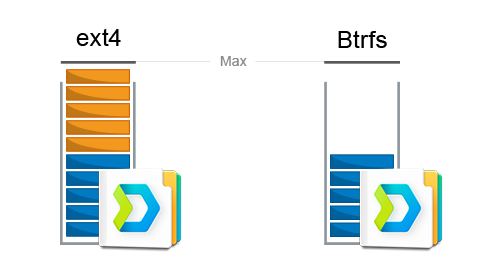
- Positioning Btrfs as a silver‑bullet performance upgrade.While Btrfs can improve perceived performance via compression and efficient cloning, it introduces overhead and trade‑offs relative to simpler filesystems like ext4. [lw14yi] [n5s4i9] [virf6o] [owdsu1] It is not automatically faster for all workloads and can be more complex to tune.
- Better framing: “advanced storage feature set” and, where performance is the true focus, “I/O‑optimized filesystem (e.g., XFS/ext4)” rather than assuming Btrfs is always best.
- Using “Btrfs” to describe any multi‑disk pooling setup.Some discussions conflate Btrfs’s internal device pooling with using LVM, mdraid, or hardware RAID under other filesystems. [gtk5p9] [r889if] [virf6o] These are architecturally different, with distinct failure modes and operational practices.
- Better terms: “LVM on ext4/XFS”, “mdraid array”, or “hardware RAID” when those are what’s actually in use.