Write a comprehensive one-page article about "API-as-a-Service".
Model: sonar-pro
API-as-a-Service: Simplifying API Development and Deployment
Introduction
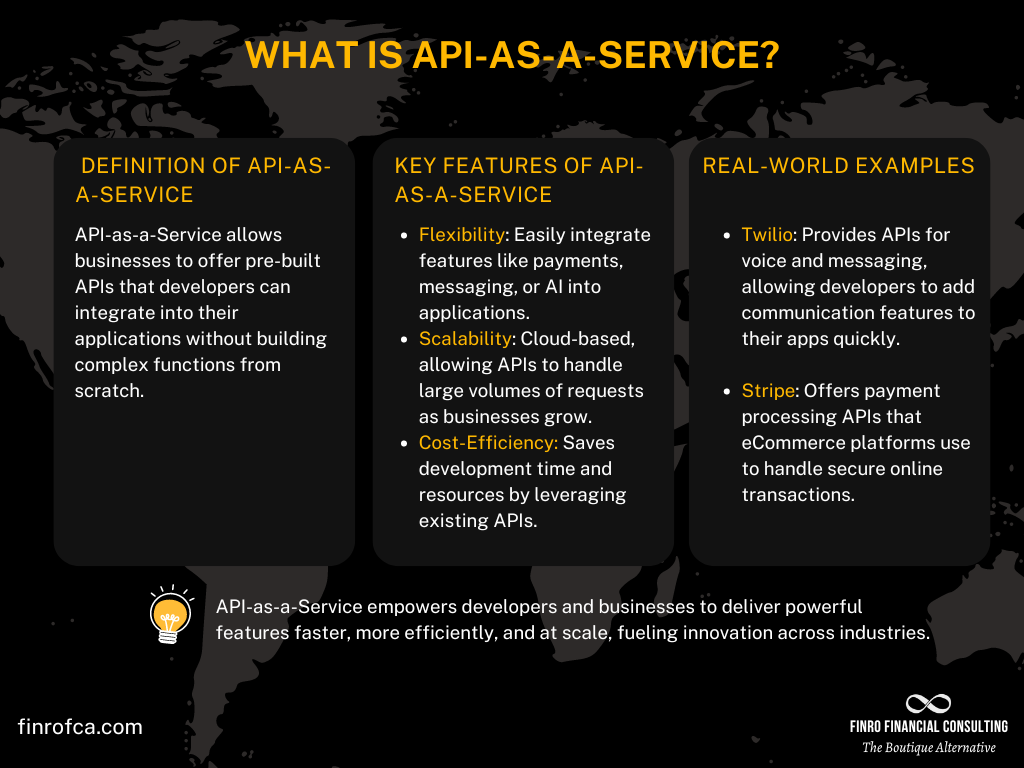
API-as-a-Service (APIaaS) is a cloud-based platform that enables businesses to design, deploy, manage, and scale APIs without handling the underlying infrastructure.
[k662mj]
[fjjk4p]
It builds on the "as-a-service" model, akin to SaaS, by offloading tasks like hosting, security, and monitoring to specialized providers.
[k662mj]
This matters in today's digital economy, where APIs power integrations between apps, accelerating innovation and reducing development costs for companies of all sizes.
[z74dfm]
Explainer
At its core, APIaaS provides an all-in-one platform for API lifecycle management. Providers offer user-friendly tools for defining endpoints, setting access controls, and deploying APIs in the cloud, complete with automatic scaling, load balancing, versioning, and documentation.
[k662mj]
[fjjk4p]
Unlike traditional API development, which requires in-house servers and DevOps expertise, APIaaS lets developers focus solely on their business logic—the provider handles the rest.
[z74dfm]
Consider practical examples: A fintech startup uses APIaaS to quickly expose payment processing endpoints, integrating seamlessly with e-commerce sites without building custom servers.
[fjjk4p]
In healthcare, a platform like Backendless allows apps to connect to third-party APIs for patient data retrieval while managing custom APIs for internal workflows.
[yqvcf8]
E-commerce giants leverage it for microservices, breaking monolithic apps into independent, scalable services that communicate via APIs, enhancing agility.
[fjjk4p]
[o4qekz]
The benefits are compelling: It slashes costs by up to 50-70% through pay-as-you-go models, boosts developer productivity with no-code/low-code tools, and ensures enterprise-grade security via built-in authentication and throttling.
[fjjk4p]
[z74dfm]
Applications span digital transformation, enabling faster time-to-market for IoT devices, mobile apps, and partner ecosystems.
[22iqsk]
However, challenges include vendor lock-in, where migrating APIs between platforms can be tricky, and ensuring compliance with regulations like GDPR in sensitive sectors.
[syl0gf]
Current State and Trends
APIaaS adoption is surging, driven by cloud-native architectures and microservices, with the API management market projected to exceed $10 billion by 2026.
[z74dfm]
Key players include AWS API Gateways for scalable, fully managed APIs handling millions of calls; Backendless for no-code API building; and Tyk for secure, developer-friendly gateways.
[yqvcf8]
[z74dfm]
[upmpr2]
Recent trends emphasize AI integration for auto-generated APIs and serverless computing, as seen in platforms streamlining microservices for resilient, language-agnostic deployments.
[fjjk4p]
[o4qekz]
Future Outlook
Looking ahead, APIaaS will evolve with edge computing and AI-driven automation, enabling real-time, global API orchestration and zero-touch management.
[k662mj]
This could democratize API creation for non-developers, fostering explosive growth in ecosystems like Web3 and autonomous systems, while amplifying impacts on business agility and cross-industry collaborations.
[22iqsk]
Conclusion
APIaaS transforms APIs from complex infrastructure burdens into accessible, scalable assets that drive efficiency and innovation.
[k662mj]
[fjjk4p]
As digital integration becomes ubiquitous, embracing APIaaS positions businesses to thrive in an interconnected future.