


AI Powered Sentiment Analyzers
(2025-11-26T15:44.181Z)
Perplexity Query
(2025-11-26T15:44
.181Z)
Question:
Write a comprehensive one-page article about "AI Powered Sentiment Analyzers".
Model: sonar-pro
AI-Powered Sentiment Analyzers
AI-powered sentiment analyzers are advanced tools that use artificial intelligence (AI), particularly natural language processing (NLP) and machine learning, to automatically determine the emotional tone behind written text. These systems categorize sentiments as positive, negative, or neutral, helping organizations understand public opinion, customer feedback, and employee morale at scale. In today’s data-driven world, where vast amounts of user-generated content are produced daily, sentiment analyzers are essential for making sense of emotions expressed online and turning them into actionable insights.
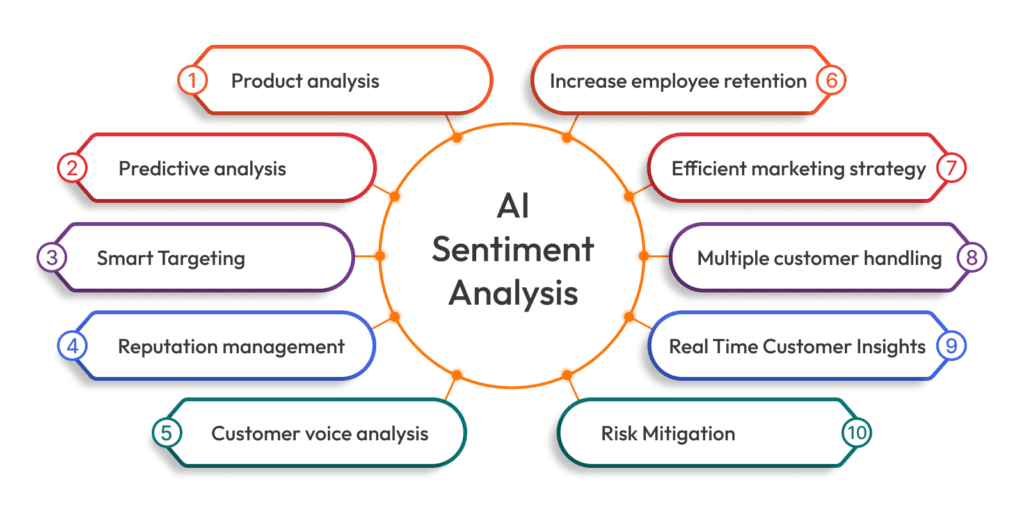
How AI-Powered Sentiment Analyzers Work
At their core, AI-powered sentiment analyzers process large volumes of text—such as social media posts, customer reviews, survey responses, and support conversations—to identify and classify emotional cues. These tools rely on machine learning models trained on labeled datasets, allowing them to recognize patterns, context, and even subtle nuances like sarcasm or irony. For example, a model might learn that the phrase “This product is so great” is positive, while “This product is so great I can’t believe it’s free” could be sarcastic and actually negative.
Practical applications are widespread. Retailers like Amazon use sentiment analysis to monitor customer reviews and refine product offerings. Healthcare providers, such as UnitedHealth Group, analyze patient and employee feedback to improve service quality and workplace satisfaction. Financial institutions leverage sentiment data to track market trends and investor sentiment, with tools like IBM Watson providing real-time insights. In marketing, companies tailor campaigns based on emotional responses, boosting engagement and conversion rates.
The benefits are significant. Businesses can respond to customer feedback in real time, address negative sentiment before it escalates, and identify emerging trends. Sentiment analyzers also help organizations benchmark their brand against competitors, optimize marketing strategies, and make data-driven decisions for product development. For example, Klarna’s AI assistant reduced average customer issue resolution time from 11 minutes to just 2 minutes by leveraging sentiment analysis.
Surface User Sentiment with Behavioral Data
www.fullstory.comDespite these advantages, challenges remain. Sentiment analysis can struggle with context, cultural nuances, and complex language. Models may misinterpret sarcasm or regional slang, and accuracy depends heavily on the quality and diversity of training data. Additionally, privacy concerns arise when analyzing personal communications, requiring careful ethical considerations.

Current State and Trends
AI-powered sentiment analyzers are now widely adopted across industries, from retail and healthcare to finance and customer service. Leading technology providers like IBM, AWS, and specialized platforms such as Thematic and V7 Labs offer robust sentiment analysis tools. The market is growing rapidly, driven by the increasing volume of digital communication and the need for real-time insights.
Recent advancements include the use of large language models (LLMs) and transformer architectures, which offer improved contextual understanding and nuanced sentiment detection. These models require less manual preprocessing and can scale to process massive datasets efficiently. Companies are also integrating sentiment analysis into chatbots and customer support systems, enabling more empathetic and effective interactions.
Future Outlook
Looking ahead, AI-powered sentiment analyzers will become even more sophisticated, with enhanced capabilities to detect subtle emotions and adapt to evolving language trends. We can expect deeper integration with other AI technologies, such as emotion recognition in voice and video, and broader applications in areas like mental health monitoring and public policy. As these tools continue to evolve, they will play an increasingly vital role in shaping how organizations understand and respond to human sentiment.

Conclusion
AI-powered sentiment analyzers are transforming the way businesses and institutions interpret and act on emotional data. By automating the analysis of vast text datasets, these tools provide real-time insights, improve decision-making, and foster stronger connections with customers and employees. As technology advances, their impact will only grow, making them indispensable in our increasingly digital world.
Citations
[1]: 2025, Nov 24. Using AI for Sentiment Analysis: Applications and Benefits - Nurix AI. Published: 2025-07-07 | Updated: 2025-11-24
[2]: 2025, Nov 18. The Impact of AI Sentiment Analysis: Benefits and Use Cases. Published: 2024-01-12 | Updated: 2025-11-18
[3]: 2025, Nov 25. The Impact of AI Sentiment Analysis: Benefits and Use Cases. Published: 2024-12-26 | Updated: 2025-11-25
[4]: 2025, Nov 26. AI Sentiment Analysis: Definition, Examples & Tools [2024] - V7 Go. Published: 2024-09-18 | Updated: 2025-11-26
[5]: 2025, Nov 25. Sentiment Analysis: Techniques, Applications, and Benefits. Published: 2024-05-19 | Updated: 2025-11-25
[7]: 2025, Nov 26. A complete guide to Sentiment Analysis approaches with AI - Thematic. Published: 2020-01-01 | Updated: 2025-11-26
[8]: 2025, Nov 25. Using AI sentiment analysis to track your reputation—Benefits and .... Published: 2024-07-08 | Updated: 2025-11-25