


AI-Augmented Knowledge Work
Defining and Describing AI-Augmented Knowledge Work
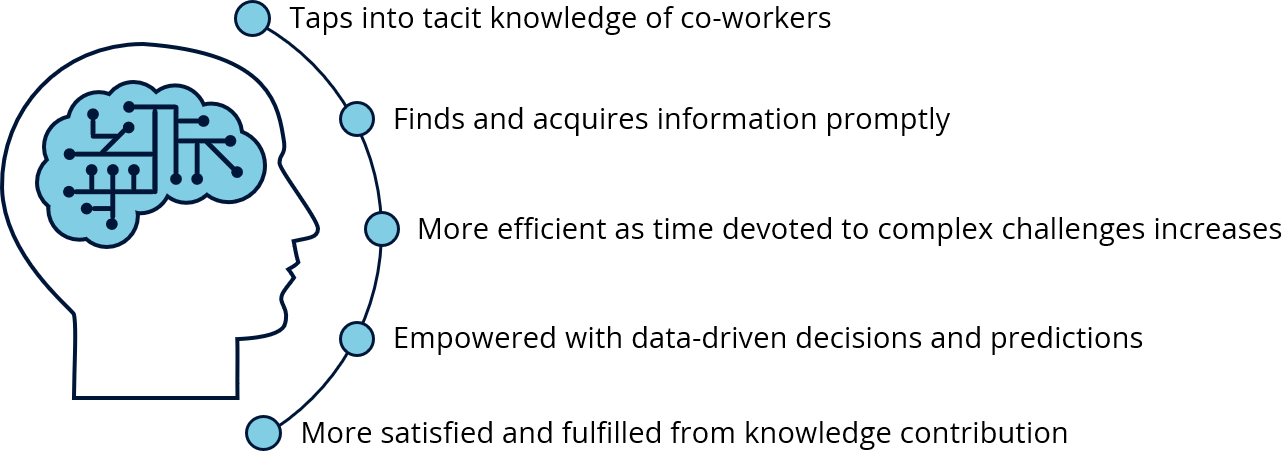
Uses in Context
- Organizations use the phrase to describe AI-driven knowledge management, where AI “captures, organizes, and applies knowledge at scale.” [iq4a94]
- In research on workplace AI, the term is used to describe augmentation, meaning AI works with humans rather than fully automating them. [talz4g]
- In business and operations contexts, it is invoked for workflows where AI handles “time-consuming tasks like data analysis or routine knowledge-sharing.” [9b1b5f]
- In discussions of generative AI, it refers to tools that raise productivity in knowledge work by accelerating drafting, retrieval, and synthesis. [jtc4vo]
- In management and consulting writing, it describes human-AI partnerships that let professionals spend more time on higher-value judgment, while AI handles routine or repetitive work. [kt6v6o]
- In knowledge-management literature, it is framed as embedding intelligence “directly into how knowledge is captured, structured, and reused.” [iq4a94]
History of Use
Origins
- The closest explicit phrasing in the provided sources is AI-driven knowledge management, described as using AI to support and automate the “entire knowledge lifecycle” across an organization. [iq4a94]
- That framing appears in contemporary knowledge-management writing rather than as a single named origin event for the exact phrase “AI-augmented knowledge work.” [iq4a94]
- Academic work on AI in labor and judgment provides the conceptual basis by distinguishing automation from augmentation, which later became central to workplace AI discourse. [talz4g]
Evolution
- 2024: Research on generative AI and knowledge work described the “rapid large-scale adoption” of generative AI tools by knowledge-work organizations and linked that adoption to productivity benefits. [jtc4vo]
- 2024: Management science research formalized the distinction between AI replacing humans and AI working with humans, reinforcing augmentation as a distinct mode of value creation. [talz4g]
- 2024–2025: Knowledge-management writing shifted from manual systems toward AI-native workflows, emphasizing that AI can be embedded into daily work instead of requiring employees to separately manage knowledge. [iq4a94]
Best Real-World Examples
- AI-driven knowledge management — a knowledge-management approach that uses AI to capture, organize, and apply organizational knowledge at scale. [iq4a94]
- Generative AI in knowledge work — research describing large-scale workplace adoption of generative AI tools and their productivity benefits. [jtc4vo]
- Human-AI augmentation research — a study separating AI’s role as automation from its role as augmentation in judgment tasks. [talz4g]
- IBM’s future-of-work framing — a corporate example describing AI taking on routine knowledge-sharing and data-analysis work. [9b1b5f]
- McKinsey’s people-agent-robot partnerships — an example of professional work being augmented by AI rather than fully automated. [kt6v6o]
- Intelligent Knowledge Management Systems — a scholarly venue focused on integrating human expertise with AI and LLMs in knowledge work. [pvq4m2]
Case Studies
AI-driven knowledge management is a concrete example of the concept because it explicitly reframes knowledge work as a lifecycle of capture, organization, and reuse supported by AI.
[iq4a94]
The Knowledge Management Institute describes this model as using AI to “capture, organize, and apply knowledge at scale,” and argues that it changes how organizations create value and how knowledge workers contribute.
[iq4a94]
In that framing, the worker is not removed; instead, AI reduces manual overhead and makes knowledge more accessible inside daily work.
[iq4a94]
Generative AI adoption in knowledge work provides a second case study at the level of the broader labor market.
[jtc4vo]
An ACM paper on “The Future of Knowledge Work” reports the “rapid large-scale adoption” of generative AI tools by knowledge-work organizations and companies, linking that adoption to productivity gains.
[jtc4vo]
This shows the concept in action as a shift in professional practice: AI becomes part of writing, analysis, and synthesis workflows, allowing people to move faster while still making the final judgments.
[jtc4vo]
A third case study comes from the management-science literature on collaboration with humans.
[talz4g]
The Informs paper distinguishes tasks where AI replaces humans from tasks where it augments them, using judgment work as the key setting.
[talz4g]
That distinction is important because AI-augmented knowledge work is strongest when the job involves uncertainty, interpretation, or context-dependent decisions, where AI can assist without being the sole decision-maker.
[talz4g]