Streamline workflows across industries with powerful AI agents. Build and deploy automated workflows using any LLM and cloud platform.
Autogen, the programming framework for Agentic AI
ℹ️(2025-11-16T23:12.468Z)
Perplexity Query
(2025-11-16T23:12
.468Z)
Question:
Write a comprehensive one-page article about "AI Agent Frameworks".
Model: sonar-pro
AI Agent Frameworks: Powering the Next Generation of Autonomous Software
Artificial Intelligence (AI) agent frameworks are foundational platforms or libraries that enable the creation, deployment, and management of autonomous software agents—digital entities capable of perceiving their environment, making decisions, and executing complex tasks independently.
[22kira]
[gs8oc9]
[5mksrz]
[t7z4td]
As businesses and developers seek to automate more sophisticated operations, these frameworks have become essential for scaling and operationalizing AI, making the development of intelligent systems more efficient and consistent.
[22kira]
[5mksrz]
AI agent frameworks provide structured environments and pre-built components, including memory modules, planning algorithms, reasoning engines, and communication protocols.
[22kira]
[gs8oc9]
[5mksrz]
[t7z4td]
These elements allow developers to build agents that not only interact with users or environments but also collaborate with other agents and systems to handle complex, multi-step tasks. Unlike traditional programs or basic chatbots, agents built on these frameworks can dynamically plan, learn, adapt, and carry context across interactions.
[22kira]
[t7z4td]
Practical Examples and Use Cases
Customer Service Automation: Companies like MoveWorks use agent frameworks to deploy multiple AI-driven support agents that handle tasks such as resetting passwords, onboarding new employees, or managing access to resources. These agents communicate seamlessly to avoid duplication and increase reliability.
[22kira]
[t7z4td]
Multi-Agent Workflows: Frameworks like Microsoft's open-source Agent Framework and LangChain’s LangGraph enable orchestration of multiple specialized agents. In a data analysis scenario, one agent extracts relevant data, another runs processing algorithms, and a third interprets results for stakeholders, all within a coordinated workflow.
[sm3inb]
[5mksrz]
Business Process Automation: Agents built with frameworks can automate end-to-end workflows such as invoice processing—extracting information from emails, validating against databases, and triggering follow-up actions without human intervention.
[t7z4td]
The principal benefits include rapid scalability, reusability of workflows, and significant reductions in development time due to ready-to-use modules.
[22kira]
[5mksrz]
[t7z4td]
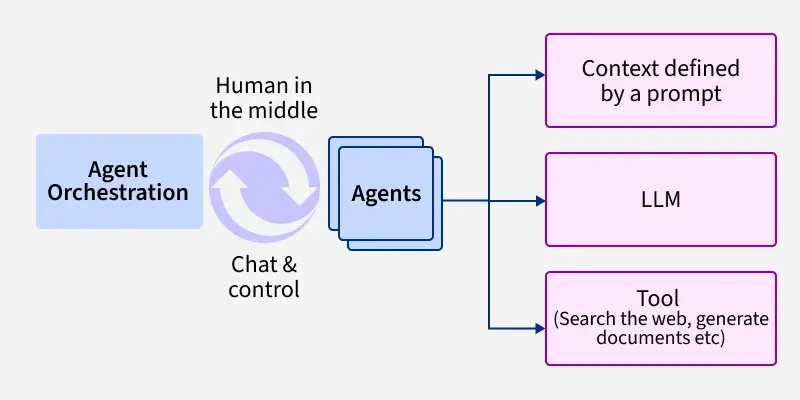
Developers can focus on high-level goals instead of low-level infrastructure, and organizations achieve faster time-to-value. By supporting “human-in-the-loop” patterns, these frameworks also allow for blending automation with human oversight when necessary.
[sm3inb]
However, challenges remain. Ensuring robust security when agents have broad autonomy, managing complex states across long tasks, and debugging emergent agent behaviors demand careful design.
[5mksrz]
[t7z4td]
As these systems become more interconnected and capable, oversight and transparency are increasingly important.
Current State and Trends
Adoption of AI agent frameworks has surged, with enterprises and startups alike integrating them to orchestrate automation across IT, customer support, and operations.
[5mksrz]
[t7z4td]
Technologies such as Microsoft Agent Framework, LangChain, AutoGen, and frameworks within Google Cloud and AWS are leading the field, offering modularity, strong workflow management, and integration with large language models (LLMs) like GPT-4 and Llama.
[sm3inb]
[5mksrz]
[t7z4td]
[fick7b]
Recent trends focus on multi-agent collaboration, advanced memory (context) management, error recovery via “checkpointing,” and extending frameworks to support domain-specific agents.
[sm3inb]
[5mksrz]
Future Outlook
Over the coming years, AI agent frameworks are expected to become even more sophisticated. Anticipated developments include seamless integration across cloud services and on-premises systems, greater support for real-time learning and adaptation, and widespread use of autonomous multi-agent teams in fields ranging from healthcare and logistics to creative content generation.
[5mksrz]
[t7z4td]
As frameworks mature, they will likely accelerate the adoption of AI-powered automation while raising new considerations around governance, safety, and accountability.
AI agent frameworks stand as critical enablers of the future of autonomous software, driving new possibilities in automation and collaboration across industries. As these platforms evolve, they will shape how humans and intelligent systems work together to solve complex challenges.